

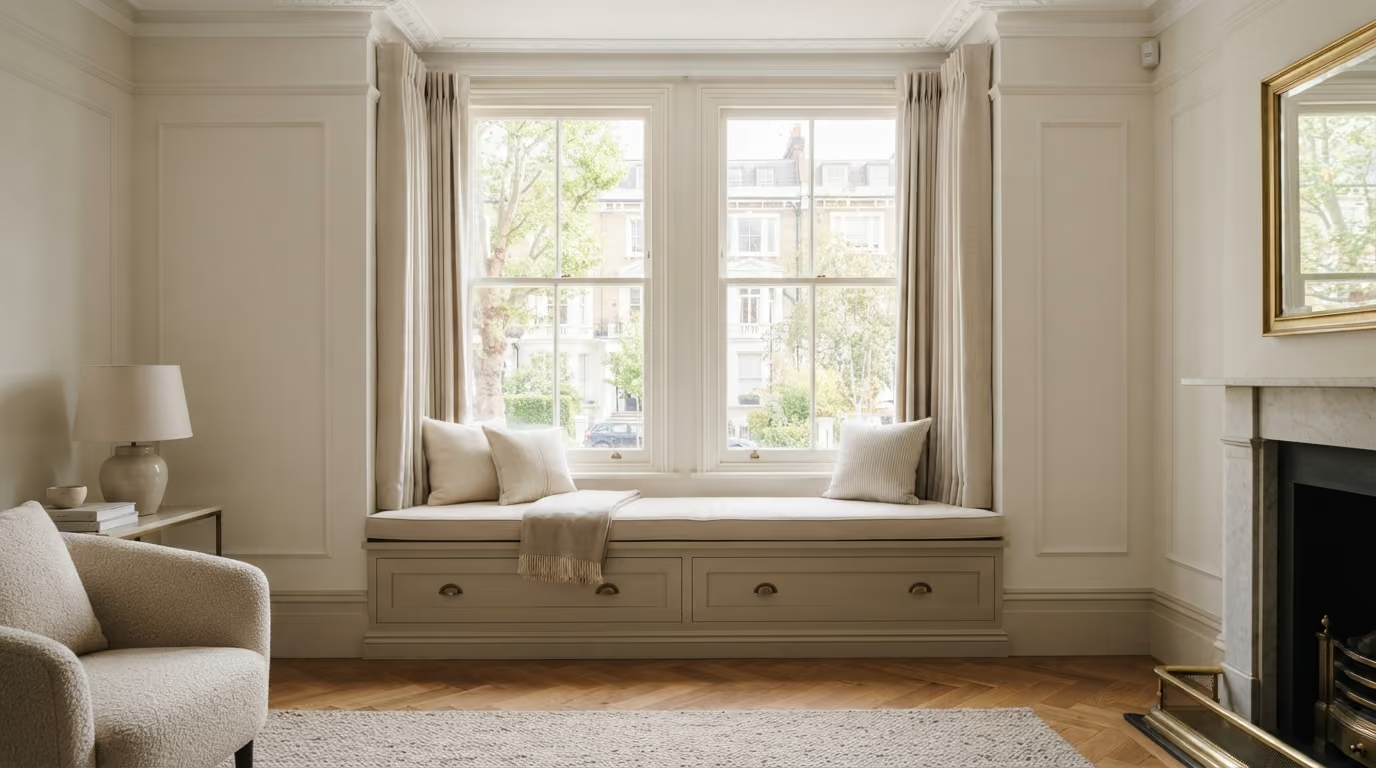
Spray finishing can give fitted window seats and built-in storage a smooth, refined appearance that complements the architecture of a Kensington period home. This guide explains how to prepare MDF and timber, choose the right colour and sheen, and coordinate storage drawers, upholstery, radiators, and surrounding window joinery for a beautiful, practical result.
The practical answer: Spray finishing can give fitted window seats and built-in storage in a Kensington home a smooth, consistent appearance that feels integrated with the surrounding architecture. It is particularly effective for bay window seating, painted storage drawers, cabinet doors, and detailed joinery where visible brush marks would detract from the finished result. The key is to assess the existing timber or MDF, prepare every surface correctly, choose a suitable coating system, and coordinate the colour with the windows, walls, flooring, and upholstery. For specialist preparation and finishing, see our interior painting and decorating service.
Window seats are a familiar feature in Kensington period homes. They make use of the space beneath tall sash windows, provide additional seating in bedrooms and reception rooms, and can incorporate discreet storage without introducing another freestanding piece of furniture.
In some properties, the window seat is an original or long-established feature. In others, it is a newly constructed addition designed to suit the proportions of a bay window or an existing alcove.
Both can benefit from careful finishing.
However, window seats have different practical requirements from ordinary fitted cabinetry. They are exposed to strong daylight, may sit close to radiators, and receive direct contact from people sitting, leaning, and moving cushions. If the joinery contains drawers or hinged storage lids, those components must continue operating properly after painting.
This guide explains when spray finishing makes sense for fitted window seats in Kensington, how to prepare timber and MDF, what to consider around sash windows and radiators, how to choose colour and sheen, and how to achieve a refined result that works with the wider room.
A fitted window seat often combines several different surfaces within a relatively compact area.
These may include:
When these surfaces are painted using different techniques or receive inconsistent preparation, the finished joinery can look less refined than intended.
Spray application can help create a more uniform surface, particularly across broad panels and repeated details.
Its main advantages include:
The result should feel like a carefully finished piece of architectural joinery rather than furniture that has simply received another coat of paint.
The correct finishing method depends on the construction and condition of the unit.
A newly installed MDF window seat with several cabinet fronts may be an excellent candidate for spray finishing.
A small original timber seat with historic paint, delicate detailing, or limited access may be more appropriately hand finished.
Before choosing the method, consider:
Spraying is a technique for applying a finish. It does not replace the need to assess the joinery or determine whether its construction is suitable for the intended use.
Many Kensington townhouses contain bay windows with several angled sections.
A fitted seat beneath these windows may follow the shape of the bay, creating multiple joints and transitions.
These changes in direction can make the finishing process more demanding.
Particular attention should be given to:
When several panels meet at different angles, small inconsistencies in surface level can become noticeable once a smooth finish is applied.
The preparation should therefore be checked across the complete unit rather than treating each panel independently.
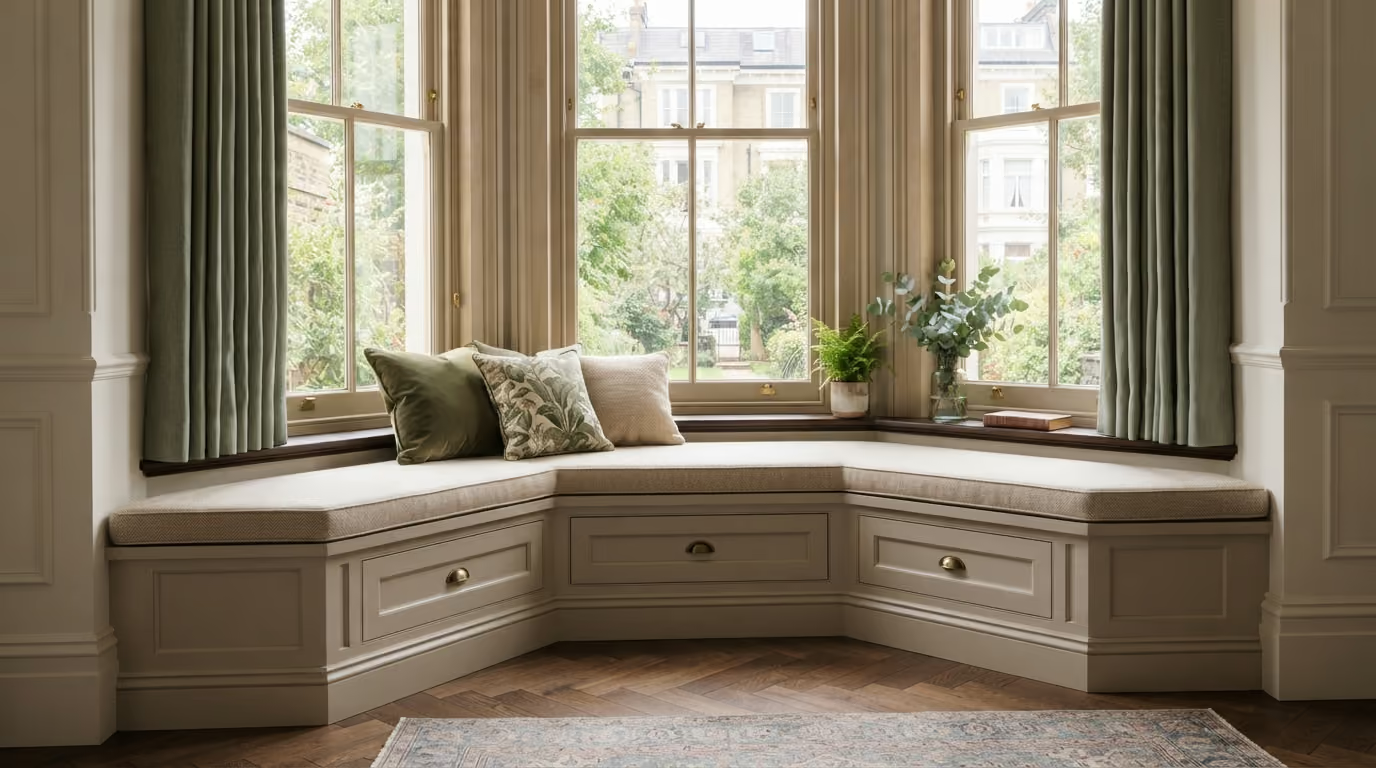
MDF is frequently used for contemporary fitted window seats because it can provide smooth broad panels and accurately shaped components.
However, cut MDF edges behave differently from the factory-finished faces.
Without appropriate preparation, these edges can appear:
This can become particularly visible around drawer fronts, panel mouldings, and exposed seat edges.
Cut edges need a suitable sealing and preparation system before the decorative finish is applied.
The goal is for the edge and face of each component to read as one continuous finished surface.
New joinery commonly contains fixing holes and small installation repairs.
These may be left by:
Each area should be prepared before spraying.
A smooth sprayed coating will follow the shape of whatever is underneath it. Raised filler, shallow dents, and poorly sanded edges may still be visible.
In fact, strong daylight from the adjoining windows can make these defects more apparent than they would be on joinery positioned elsewhere in the room.
A fitted seat does not necessarily need to be replaced because its paint is worn or the colour no longer suits the room.
Where the underlying construction remains sound, an existing painted unit may be suitable for refinishing.
The first step is to assess the previous coating.
Look for:
Stable existing paint may be prepared and retained where it is compatible with the proposed finishing system.
Loose or unsuitable coatings require further attention.
Older joinery may contain historic coatings, including potentially lead-containing paint, so the preparation method should reflect the age and condition of the existing finish.
The horizontal top of a window seat experiences more direct contact than the side panels.
People may sit on it, move cushions across it, or place books and other objects on the surface.
That means the coating needs to be selected for more than its appearance.
Consider:
A smooth finish can look beautiful, but it should also be appropriate for the way the window seat will actually be used.
No decorative paint should be assumed completely resistant to scratches, impacts, or long-term wear.
Often, yes.
Using one colour across the seating structure, front panels, and storage doors can create a more coherent architectural feature.
This is particularly effective when the seat follows the shape of a bay window.
However, different treatments can also work.
For example:
The decision should be based on the architecture and materials rather than assuming everything must match.
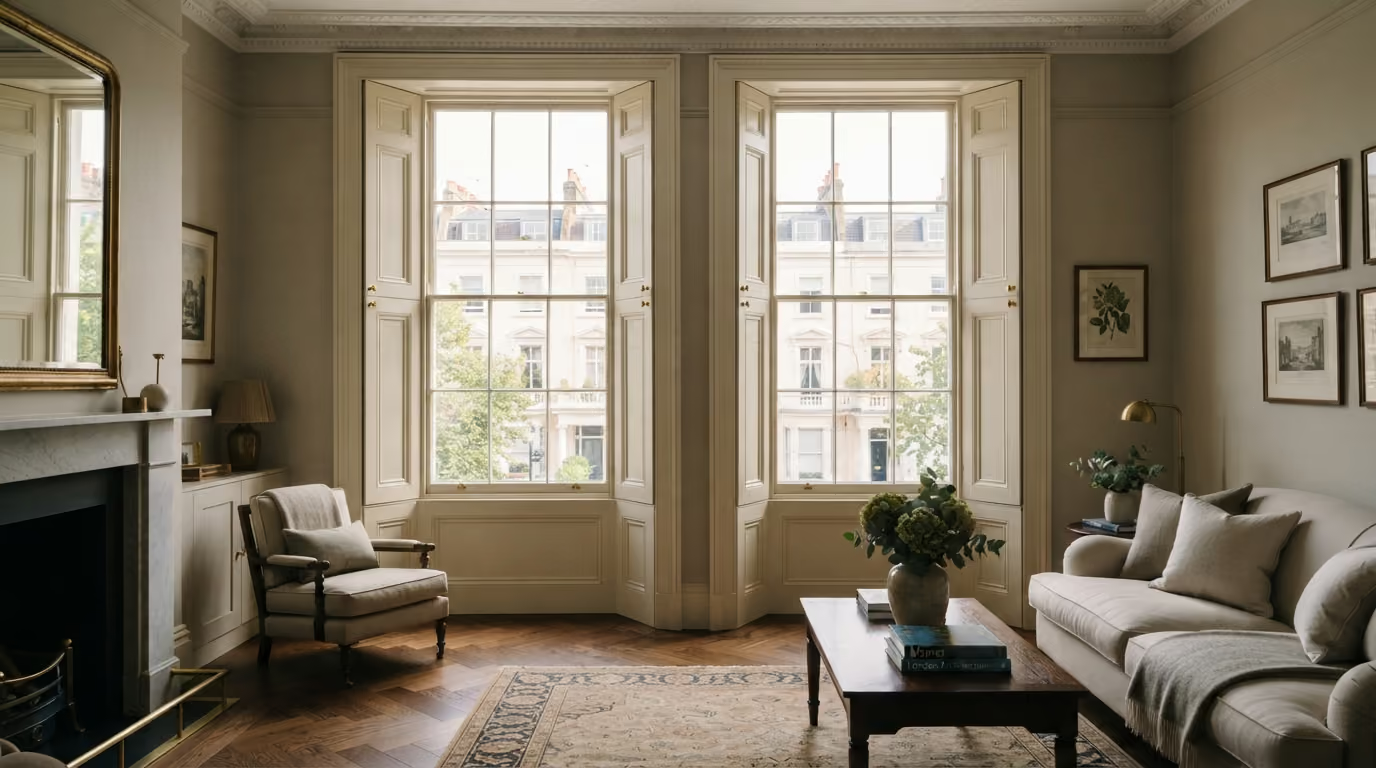
A fitted window seat sits directly beneath the windows, so the relationship between the two finishes is particularly visible.
Traditional sash windows may be painted in:
The seat can match the windows, use a related tone, or provide contrast.
A soft stone seat beneath warm off white windows may feel very natural.
A darker olive or charcoal seat can create more definition, particularly when the surrounding walls are pale.
However, a strongly contrasting colour can draw attention to the fitted seat rather than the windows and view.
The correct choice depends on which element should have the greatest visual presence.
Some fitted window seats sit directly beneath existing timber window sills.
Others incorporate a new upper surface that visually continues the window joinery.
Before decorating, check:
The transition between the original and new joinery should feel intentional.
Using similar colours can help separate elements appear more integrated, but the preparation of each substrate still needs to be appropriate.
Window seats are often positioned close to glazing and external walls.
This means their surrounding surfaces may be exposed to condensation or moisture problems that do not affect cabinetry elsewhere in the room.
Before refinishing, look for:
These problems should be investigated before the decorative work begins.
Spraying a new coating over moisture-damaged material does not correct the underlying cause.
Where the substrate has swollen or deteriorated significantly, local joinery repair or replacement may be required before refinishing.
Some period rooms contain radiators beneath bay windows, and fitted seating may have been designed around them.
In these situations, the construction needs to provide suitable heat distribution and access for maintenance.
Before decorating, check:
Paint must not be allowed to block ventilation grilles or interfere with moving or removable components.
If the radiator enclosure itself needs alteration, that work should be completed before the final finish.
Many fitted window seats contain drawers beneath the seating area.
These are useful for storing cushions, blankets, books, and other household items.
However, drawers introduce moving parts and closely fitted surfaces.
Before spraying, inspect:
A drawer that already rubs against an adjoining panel should be adjusted before painting.
Adding another coating without checking the clearance can make the problem worse.
Some window seats have lift-up lids rather than drawers.
These can provide substantial storage, but their construction introduces different finishing requirements.
Check the hinges, supporting hardware, lid alignment, and any safety mechanisms before decorating.
The areas where the lid meets the frame should be prepared and finished carefully so the coating does not cause sticking.
Where gas struts or other mechanisms are fitted, their operation and access should be considered during the finishing programme.
Decorative painting should not interfere with the safe operation of the storage lid.
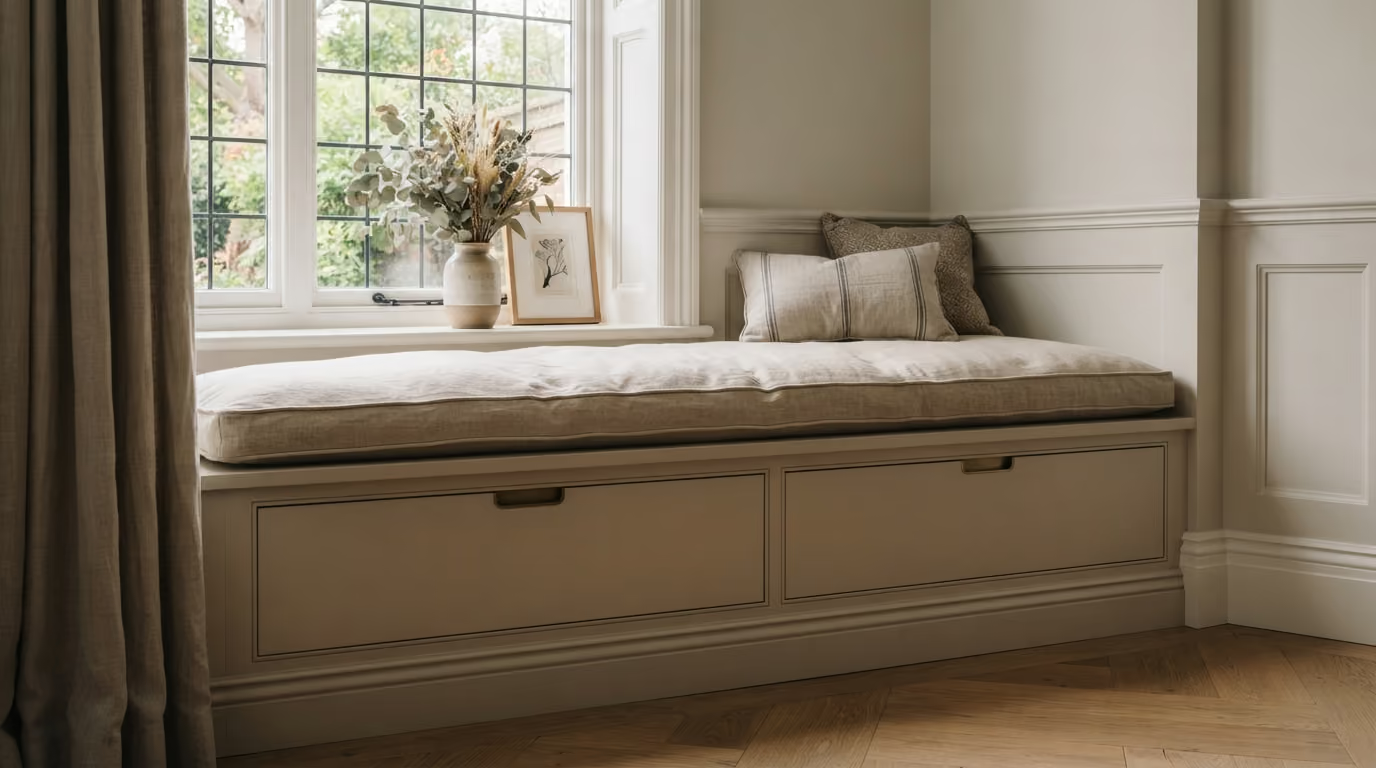
Drawer handles, recessed pulls, knobs, and hinges all affect the appearance of fitted storage.
Changing hardware after the unit has been painted can leave old fixing holes or require new drilling.
Before preparation begins, confirm:
Aged brass, bronze, dark metal, and painted handles can all work with different window seat colours.
The hardware should contribute to the design rather than being selected only after the cabinetry has been completed.
The sheen level changes how the finished joinery appears, particularly under strong daylight.
Eggshell and satinwood finishes are common choices for interior painted joinery, depending on the coating system and desired appearance.
A lower sheen may create a softer, more understated effect.
A stronger satin finish can provide more reflection and make the joinery feel visually defined.
The appropriate choice depends on:
Higher sheen can make shallow dents, sanding marks, and uneven filler more visible.
Excellent preparation becomes particularly important where a smooth, reflective finish is desired.
One of the biggest challenges with bay window joinery is the amount of natural light falling directly across it.
Tall sash windows can produce strong side lighting, particularly during the morning or afternoon.
This can reveal:
The joinery should be inspected under the actual room lighting during preparation.
A surface that looks smooth under temporary work lights may appear quite different in direct daylight.
Although many window seats are painted white, deeper colours can create an attractive architectural feature.
Possible directions include:
These colours can work particularly well when the surrounding window frames are pale and the room contains natural timber flooring.
A darker seat can make the cushion and upholstery feel more prominent, especially when they are finished in a lighter neutral fabric.
However, dark finishes can show dust, scuffs, and preparation defects more clearly under certain lighting conditions.
The choice should balance appearance with practical use.
For a quieter effect, warm stone, putty, soft off white, pale mushroom, and muted grey green can work beautifully.
These colours often sit comfortably beside:
A related colour can allow the window seat to feel like a natural part of the room rather than a separate furniture installation.
Colour samples should be viewed beside the actual windows, walls, cushion fabric, and flooring before the final selection is made.
A fitted window seat is often completed with a tailored upholstered cushion.
That cushion occupies much of the upper surface, so its colour and texture affect how the painted joinery appears.
For example:
The fabric should be considered early rather than selected after the joinery has been finished.
If the seat includes loose cushions, their size and placement can also influence how much of the painted structure remains visible.
In rooms with decorative wall panelling, using the same colour on the window seat can create continuity.
This can be particularly effective when the panelling continues around the window opening.
A coordinated approach may involve:
The right approach depends on the room's proportions and the level of architectural definition desired.
A painted window seat can create an attractive contrast beside wallpaper, particularly in bedrooms, studies, and informal reception rooms.
The colour of the joinery may be selected from one of the quieter tones within the wallcovering.
This helps connect the two finishes without requiring an exact match.
However, wallpaper installation and spray finishing should be coordinated carefully.
If new wallpaper is planned, the disruptive joinery work and preparation should normally be completed before installation.
For specialist wall preparation and installation, see our wallpaper service.
A smoothly spray finished window seat can also work well beside Bauwerk limewash.
The contrast comes from the different surface characteristics.
The joinery has a controlled and uniform appearance, while the limewash provides natural mineral variation.
Warm stone, clay, putty, and muted olive combinations can create a particularly restrained result.
If limewash is part of the scheme, any drilling, filling, or joinery installation should be completed before the final wall finish to reduce the risk of visible local repairs.
Often, yes, provided the room can be adequately protected and the chosen application system is suitable for on site use.
However, removable drawer fronts, doors, and other components may be easier to prepare and finish separately.
On site spraying requires protection for:
Suitable containment, ventilation, and product-specific safety measures should form part of the work programme.
A beautifully finished cabinet is not a successful result if the surrounding period interior has been affected by overspray.
The finish may become touch dry before it has developed its intended hardness and resistance to wear.
This matters because a window seat receives direct physical contact.
Placing heavy cushions, closing drawers tightly, or sitting on the surface too early can mark a coating that has not cured sufficiently.
The required drying and curing periods depend on the selected coating system, application conditions, and manufacturer's instructions.
The finishing programme should allow for this rather than treating the seat as ready for immediate use once the surface feels dry.
If the window seat is being installed or refinished as part of a wider renovation, the work should be coordinated with the surrounding walls, windows, and flooring.
A sensible sequence is:
The exact order may change depending on whether the seat is finished on site or its components are removed for separate preparation.
Planning the sequence helps avoid damage to newly completed walls and floors.
A successful window seat finish should make the joinery feel integrated into the room while remaining practical for everyday use. The smoothness of the sprayed coating matters, but so do the preparation, construction, colour, material choices, and relationship with the surrounding architecture.
Can an existing painted window seat be spray finished? Often, yes. If the construction is sound and the existing coating can be prepared appropriately, a fitted window seat may be refinished without replacing the entire unit.
Can MDF window seats be spray painted? Yes. MDF can provide a very smooth finish when the faces, cut edges, joints, and fixing holes are prepared correctly.
Is spraying better than brush painting for fitted window seats? Spraying can create a smoother and more consistent appearance, particularly on larger panels and detailed joinery. Hand painting may still be appropriate depending on the project.
What paint finish works best for a window seat? The correct finish depends on the joinery substrate, expected use, desired sheen, and coating system. The horizontal seating surface deserves particular attention because it receives direct contact.
Should a window seat match the window frames? It can. Matching or closely related colours often create a cohesive result, but a contrasting seat can also work when it suits the room's overall design.
Can storage drawers be sprayed? Yes. Drawer fronts and suitable cabinet components can be spray finished, provided the moving parts and clearances are considered before application.
Can a window seat be sprayed without removing it? Often, yes, when the room can be properly protected and the application method is suitable. Some removable components may be easier to finish separately.
Can painted window seats be used immediately after spraying? No. The selected coating needs sufficient drying and curing time before normal seating, cushion placement, and repeated handling resume.
We carry out interior painting, decorating, and fine finishing across Prime Central London, including Kensington, Chelsea, Belgravia, Notting Hill, Knightsbridge, and Westminster. Our work includes fitted window seats, bay window joinery, built-in storage, wardrobes, alcove cabinets, shelving, wall panelling, doors, and other architectural joinery where careful preparation and a refined painted finish are important.
Considering spray finishing for a fitted window seat in a Kensington home? Send photographs of the complete window area, including the seat top, front panels, storage drawers, window frames, surrounding walls, flooring, and any existing paint damage or moisture concerns. We can assess the visible condition, discuss suitable preparation and finishing options, and help select a colour and sheen that complements the architecture and wider interior. To begin, request a site visit and we will arrange a time that suits you.
Tell us a few details about your project and our team will review the enquiry and come back to you within one working day.


