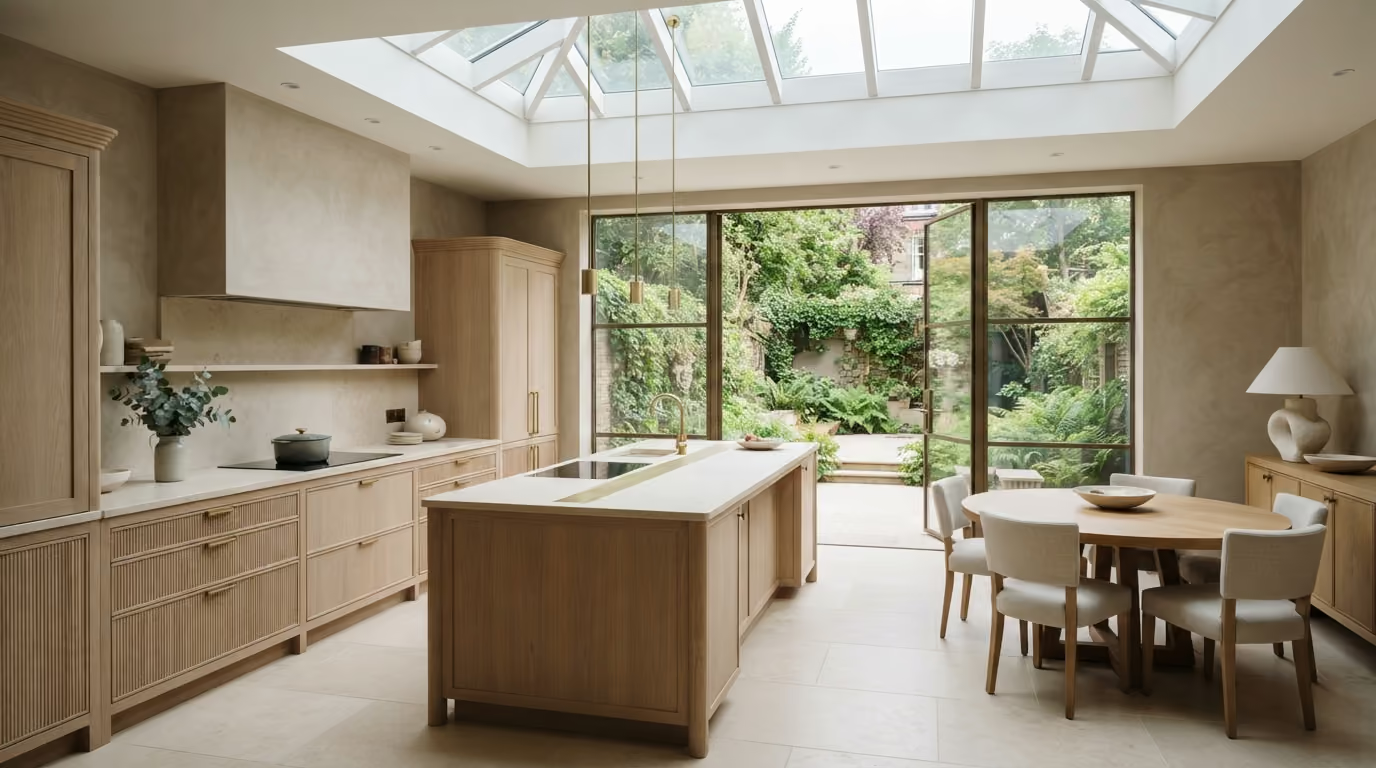
Bauwerk limewash can bring natural texture, warmth, and depth to contemporary kitchen extensions while connecting them with the character of a Kensington period home. This guide explains how to choose suitable wall locations, prepare new plaster, coordinate colours with cabinetry and natural stone, and manage kitchen moisture, cleaning requirements, and changing daylight.
The practical answer: Bauwerk limewash can create a beautiful finish in a Kensington kitchen extension, especially where contemporary architecture meets the original character of a period townhouse. Its natural mineral variation adds depth to large plaster walls, softens the appearance of modern glazing, and complements materials such as oak, limestone, marble, and painted cabinetry. However, limewash should be used selectively in a kitchen. Wall preparation, cooking moisture, cleaning requirements, direct sunlight, and areas exposed to splashes must all be considered before application. For professional advice, preparation, and finishing, see our Bauwerk limewash service.
Rear kitchen extensions have become a familiar feature of Kensington period homes. Many properties retain traditional reception rooms at the front, with contemporary kitchens and dining areas opening towards a private garden.
These extensions often introduce large glazed doors, rooflights, open-plan layouts, natural stone surfaces, and carefully designed cabinetry.
The result can be beautiful, but there is a decorative challenge.
A traditional townhouse and a contemporary extension do not always share the same architectural language. The original rooms may contain ornate cornices, fireplaces, panelled doors, and traditional plasterwork, while the new space features broad uninterrupted walls and minimal detailing.
Bauwerk limewash can help connect these different elements through colour, texture, and natural materials.
Rather than creating the completely uniform appearance of conventional emulsion, limewash introduces subtle variation that changes with the direction and quality of light.
In a kitchen extension with large windows and natural finishes, this can be particularly attractive.
This guide explains how to use Bauwerk limewash in Kensington kitchen extensions, including suitable wall locations, preparation of new and existing plaster, colour selection, kitchen splash zones, natural light, cabinetry, architectural transitions, and the practical considerations that should be resolved before decorating begins.
Modern extensions often contain larger uninterrupted wall surfaces than the original rooms of a period townhouse.
In traditional reception rooms, fireplaces, cornices, wall panelling, and doors naturally divide the space.
In a contemporary kitchen extension, one wall may run from a bank of fitted cabinets towards a large glazed opening with very little architectural interruption.
A conventional painted finish can make these surfaces appear clean and uniform.
Bauwerk limewash offers a different effect.
Its natural tonal movement introduces subtle visual depth, allowing the wall to contribute to the design without adding decorative mouldings or wallpaper.
This can be useful when the architecture is intentionally restrained.
The finish works particularly well alongside:
The aim is not to make the walls the dominant feature. It is to give them enough natural character to complement the other materials.
One of the most important decisions in a Kensington renovation is how the new kitchen should relate to the older rooms.
Some homeowners want a clear contrast between traditional and contemporary architecture.
Others prefer the extension to feel like a natural continuation of the house.
Limewash can support either approach.
For a more connected scheme, a warm mineral colour can be introduced in the extension and repeated through related painted finishes in adjoining spaces.
For example:
This creates a common colour palette without requiring the original rooms and contemporary extension to have identical finishes.
The distinction between smooth painted plaster and mineral limewash can remain visible while the colours feel closely related.
The best locations are generally walls that benefit from decorative texture without receiving frequent direct contact, cooking splashes, or intensive cleaning.
Good candidates may include:
The suitability of each surface depends on the actual substrate, expected use, and product specifications.
A wall behind a dining banquette may look attractive in limewash, but it should also be assessed for repeated contact from chairs, cushions, and people.
Likewise, a wall close to the cooking area may need a more washable or protective material.
The most successful schemes use limewash where its particular qualities are an advantage.
Not necessarily.
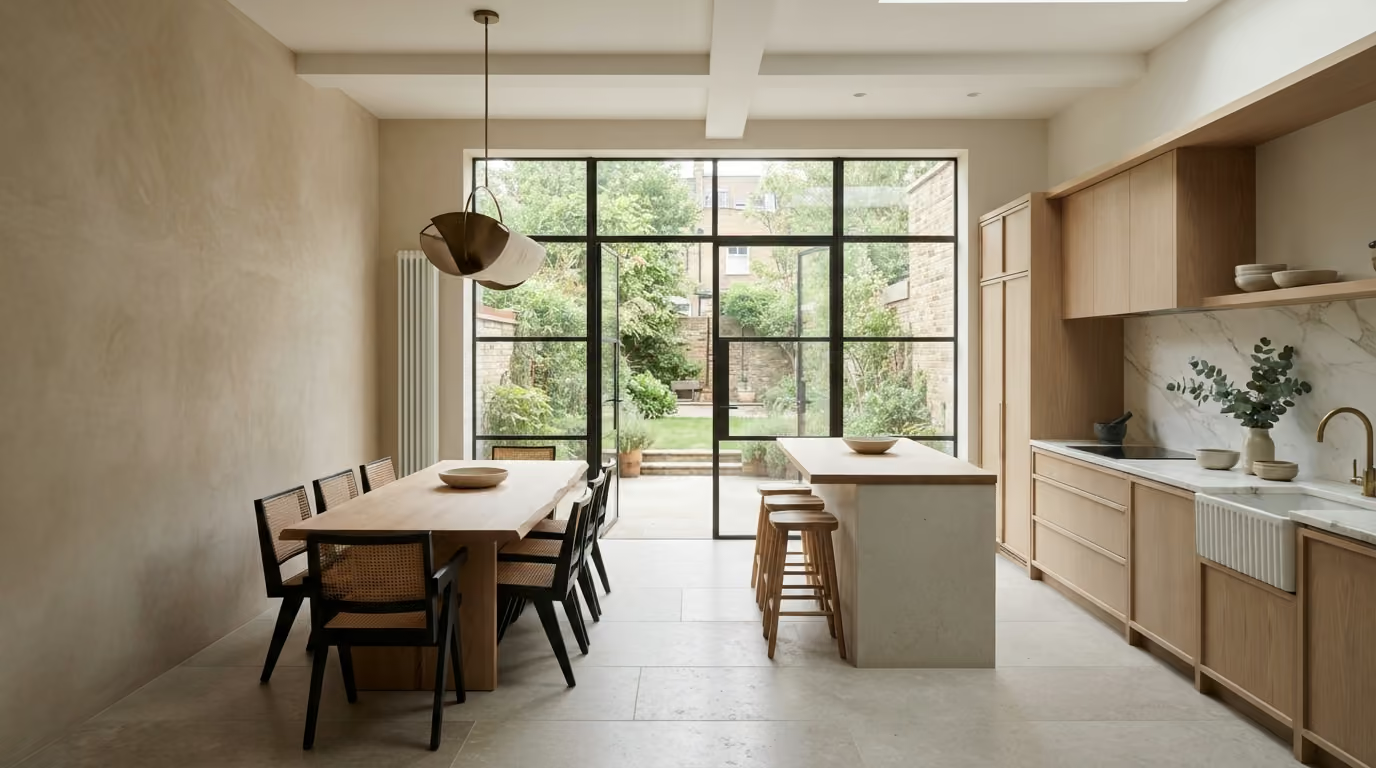
Using limewash throughout the extension can create a cohesive result, particularly when the room contains relatively few decorative elements.
However, different parts of the kitchen may have very different practical requirements.
A large wall in the dining area may be suitable for a mineral finish, while the wall immediately behind the hob or sink may require a more resistant surface.
The design can therefore combine:
This approach allows the mineral walls to remain an important part of the interior without asking them to perform in conditions for which the chosen finish may not be suitable.
A kitchen contains several areas where walls may be exposed to water, oil, food, cleaning products, and repeated wiping.
These include:
Limewash should not automatically be treated as a substitute for a conventional kitchen splashback.
The exact Bauwerk product and any proposed protective treatment must be checked for the intended conditions.
Natural mineral finishes may be more sensitive to staining and repeated cleaning than surfaces specifically designed for intensive kitchen use.
Where regular splashing or grease exposure is expected, a suitable stone, tile, glass, or other approved surface may be the more practical choice.
Protective products may be available for certain mineral finishes and applications, but they should not be assumed to make every limewashed wall suitable for intensive cleaning or direct water exposure.
Before selecting a sealer, consider:
A protective treatment may alter the natural look of the finish.
It is worth testing the complete proposed system rather than judging the unsealed limewash sample alone.
In many kitchen extensions, it is more practical to keep limewash on suitable decorative walls and use purpose-designed materials where intensive cleaning is expected.
One of the defining characteristics of a modern kitchen extension is the amount of natural light entering the room.
Full-height glazing, rooflights, and sliding garden doors can make the interior feel bright and open.
They can also reveal every detail of a wall finish.
Limewash responds particularly noticeably to changing light.
A pale mineral wall may appear soft and relatively uniform in indirect daylight, then show stronger tonal movement when sunlight travels across it at an angle.
This is part of its decorative appeal.
However, strong side lighting can also reveal:
Preparation and sampling should take account of the actual daylight conditions in the extension.
Not every Kensington garden extension receives strong direct sunlight.
Some are shaded by neighbouring buildings, boundary walls, mature trees, or the orientation of the property.
In a room with cooler, indirect daylight, certain mineral colours can appear more subdued than expected.
Very cool greys may feel cold beside pale stone and modern glazing.
Warmer putty, clay, mushroom, and restrained stone colours may provide a softer appearance.
However, undertones should be checked against the actual materials in the room.
Samples should be viewed in the morning, afternoon, and under the lighting used in the evening.
A colour selected under showroom lighting may behave quite differently inside a shaded rear extension.
Where an extension receives substantial direct sunlight, the limewash may look more varied at different times of day.
Strong sunshine can reveal the surface movement and colour differences within the finish.
This is especially noticeable on broad uninterrupted walls.
Warm sunlight can also change how the undertones are perceived.
A pale clay shade may appear warmer in the afternoon than it does under cool morning light.
When testing colours, consider both the brightest and most shaded conditions likely to occur.
The preferred finish should look attractive throughout normal daily use rather than only at one particular time.
Many contemporary kitchen extensions have flat rooflights or pitched glazed sections above the dining area.
These introduce natural light from above, sometimes illuminating walls much more directly than traditional sash windows would.
This can make mineral variation particularly visible.
It can also make preparation defects difficult to ignore.
A large limewashed wall beneath a rooflight should therefore receive careful surface preparation and be assessed under natural light before the final decorative application.
The colour should be selected in relation to the largest permanent materials within the room.
These normally include:
In a high-end kitchen, these materials often occupy more visual space than the accessories and loose furniture.
The wall colour should support the materials rather than compete with them.
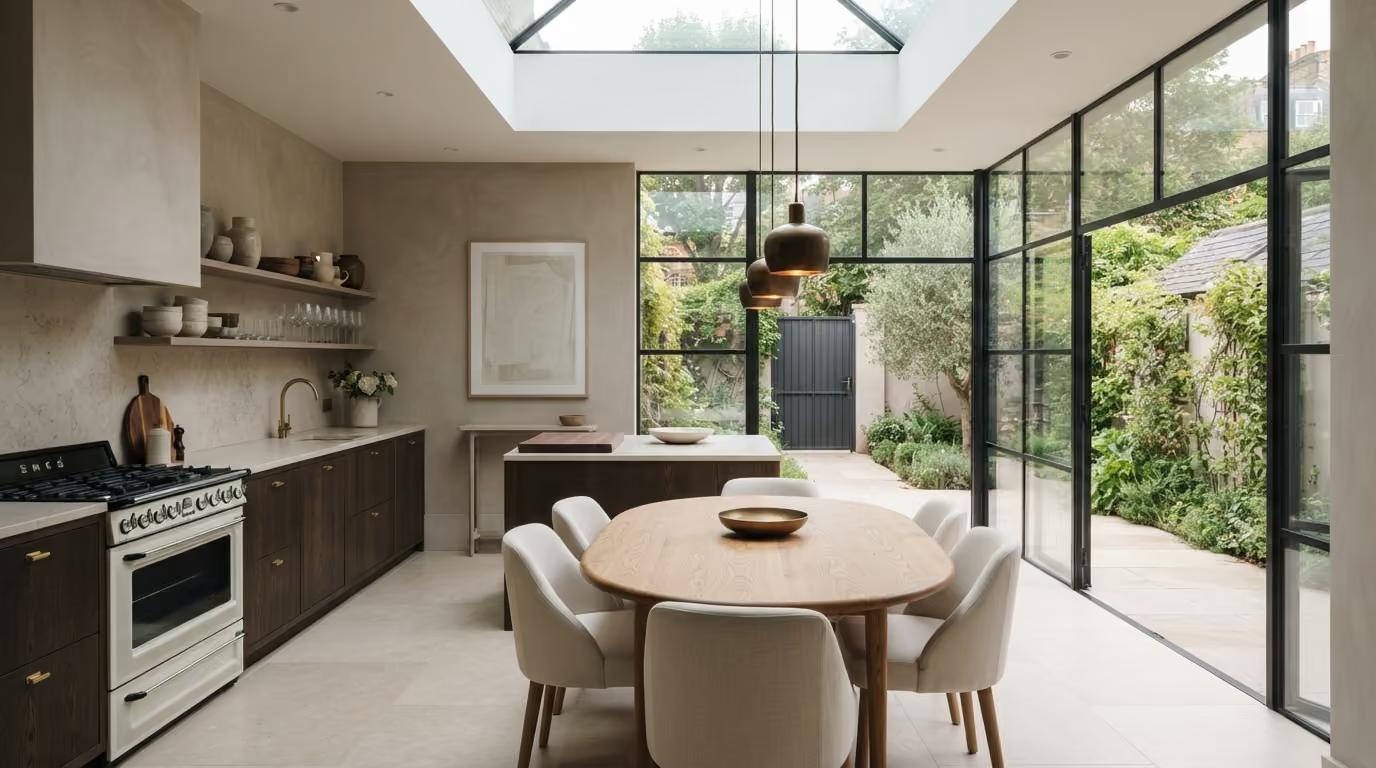
For example, a warm stone limewash may complement pale oak cabinetry and limestone flooring, while a muted olive can provide contrast beside natural timber and light marble.
A deeper clay colour may suit a kitchen with warm bronze details and darker wood.
There is no universal colour that works with every kitchen extension.
The most reliable approach is to test several appropriate shades alongside the actual material samples.
Warm stone and putty are particularly versatile choices for Kensington kitchen extensions.
They can create an understated background for:
These colours often work well when the goal is to connect contemporary architecture with the quieter palette of the original townhouse.
However, warm neutrals can contain quite different undertones.
Some lean towards yellow, others towards pink, green, or grey.
The difference may be subtle on a sample but noticeable when an entire wall is completed.
Soft olive, sage, and muted green tones can work beautifully in kitchen extensions overlooking private gardens.
They create a visual relationship between the interior and the greenery outside.
This can be effective when the room contains:
However, a green wall should not automatically be selected because the room overlooks a garden.
The actual undertone needs to work with the worktops, cabinets, and flooring.
A yellow-green limewash may look very different beside cool marble than it does beside warm oak.
Large kitchen extensions can sometimes accommodate darker limewash colours without feeling enclosed.
This is particularly true where the room receives generous natural light and contains broad glazed openings.
Deeper clay, tobacco, muted charcoal, and warm olive can create a strong contrast with pale cabinetry.
They may work particularly well on a dining wall or within a separate seating area.
However, the colour should be considered in relation to evening lighting.
A dark mineral wall may feel atmospheric during dinner but much more prominent during the day.
The finish should be sampled at a suitable scale before committing to a large surface.
Newly built extensions often contain fresh plaster, plasterboard, or other modern wall construction systems.
These surfaces need to be assessed before limewash is applied.
It is important to distinguish between traditional mineral plaster, modern gypsum plaster, painted surfaces, and other substrates.
Bauwerk limewash requires a preparation system appropriate for the actual surface.
Not every new plaster wall can simply receive limewash directly.
The correct approach depends on:
The full system, including any required primer or preparation coat, should be established before application begins.
In some Kensington properties, the kitchen extension was completed several years ago and already has painted walls.
Homeowners may now want to replace the conventional emulsion with a more textured mineral finish.
This may be possible, but the existing paint must be assessed.
Look for:
Sound previously painted walls generally require a suitable compatible preparation system for the chosen Bauwerk product.
The new finish should not be applied over unstable coatings or contaminated areas.
For kitchen walls, removing accumulated grease and other residues can be especially important before decorative preparation.
It is a common misconception that a textured or naturally varied finish can conceal any defect in the wall beneath it.
Bauwerk limewash creates visual movement through its application and mineral character.
That is different from correcting:
These defects should be assessed and repaired as appropriate before the decorative application.
Strong light from garden glazing and rooflights can make poor preparation particularly visible.
A rear extension creates a junction between existing and newly built parts of a property.
Different building materials and construction methods may behave differently over time.
Cracks can sometimes appear where:
These cracks should not automatically be treated as cosmetic.
Where cracking is recurring, widening, or associated with movement, the cause should be assessed before decoration.
Limewash is not a structural repair system and will not prevent an active crack from reopening.
Mineral finishes are sometimes associated with traditional breathable construction, but the behaviour of a completed wall depends on the entire system, including the substrate and any primers or protective treatments.
Applying limewash does not resolve damp or water ingress.
Before decorating, investigate:
The cause should be corrected and the surface made suitable for the proposed finish before work proceeds.
Painted cabinetry is one of the largest visual elements in many Kensington kitchen extensions.
Its finish is usually smoother and more uniform than mineral limewash.
This difference can be attractive when the colours are carefully coordinated.
For example:
The cabinet finish should be selected for joinery use, and the wall finish should be chosen for the wall substrate and intended conditions.
Even where both are described by similar colour names, they may look different because of sheen and surface texture.
Samples should be viewed together under the actual room lighting.
Natural oak is a popular material for contemporary kitchens because it provides warmth without requiring a strong decorative colour.
It can work particularly well beside limewash.
The two materials offer different textures:
Warm stone and pale putty often complement light oak.
Deeper olive, clay, and tobacco shades may be suitable where more contrast is desired.
The oak's actual finish should influence the decision.
A pale, natural-looking oak cabinet will respond differently from smoked, stained, or heavily toned timber.
Natural stone has its own colour variation and surface character.
Marble may contain fine grey veining, warmer cream movement, or stronger contrasting patterns.
Limestone may have a quieter texture with subtle shifts in beige, cream, or grey.
The limewash should be tested directly beside these materials.
A neutral shade that appears balanced against oak may look unexpectedly pink or yellow when viewed beside the worktop.
Where the stone contains strong movement, a restrained limewash colour can help preserve visual balance.
There is rarely a need for both the wall and the worktop to become competing decorative features.
In open-plan extensions, the island often occupies the centre of the room.
Its colour and material may be different from the cabinets along the walls.
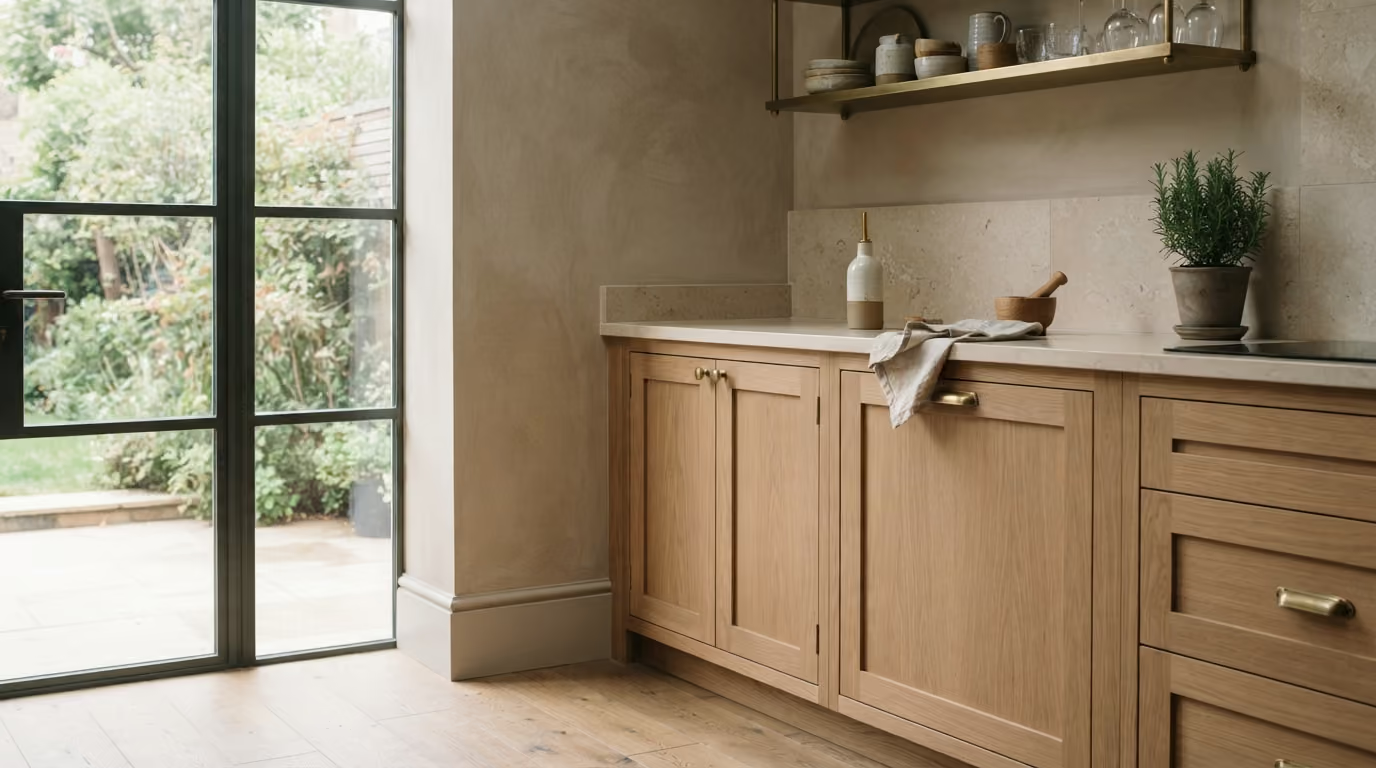
For example, a kitchen may combine pale oak perimeter cabinets with a dark painted island.
In this situation, the limewash should be assessed against both elements.
A warm neutral wall may provide the balance needed between the timber and darker cabinetry.
Alternatively, a deeper mineral colour in the dining area can create separation between the cooking and seating spaces.
The important point is to consider the entire room rather than selecting the wall finish independently.
Yes.
Open-plan kitchen extensions often combine several activities within one room.
These may include:
Using limewash on the dining wall can help give that part of the extension its own identity.
This is particularly effective where the kitchen cabinetry already provides strong architectural definition elsewhere.
The mineral wall becomes a quieter background for the dining table, artwork, and lighting.
There is no need to use dramatically different colours to define the separate areas.
A change in surface character may be sufficient.
Some Kensington kitchen extensions contain built-in dining banquettes positioned directly against a wall.
This can be an attractive location for limewash, but the practical use needs to be considered.
People may lean against the wall, cushions may rub against it, and chairs may occasionally make contact.
Before choosing the finish, consider:
In some schemes, a painted timber backrest or upholstered wall panel can protect the lower section while limewash continues above.
This allows the mineral finish to contribute to the room without being exposed to unnecessary wear.
Large contemporary extensions can have several different ceiling conditions.
There may be:
The ceiling colour should be planned alongside the limewashed walls.
A pale painted ceiling can maintain brightness and create a clean boundary.
A related warmer shade may provide a softer transition.
Applying limewash to a ceiling may also be possible where the product and surface preparation system are suitable, but overhead application requires specific assessment and planning.
There is no requirement to repeat the wall finish on every surface.
Kitchen extensions are often designed around daylight, but they also need to work during the evening.
Pendant lights, concealed lighting, wall lights, and recessed fixtures can all affect how limewash appears.
Warm lighting may make a mineral wall feel softer and richer.
Directional lighting can emphasise the texture and tonal variation.
However, it may also reveal preparation defects.
Before the final colour is approved, samples should be viewed under the lighting scheme intended for the completed room.
This is particularly important in kitchen-dining spaces used for evening entertaining.
A modern extension may contain a single uninterrupted wall several metres wide.
This makes the application process especially important.
The finishing team needs to plan how the limewash will be applied across the surface while following the manufacturer's instructions.
Factors include:
Natural tonal variation is expected, but the overall appearance should feel deliberate and balanced.
It should not be confused with random defects caused by poor preparation or an inconsistent application process.
The correct number of coats depends on the specific Bauwerk product, colour, substrate, preparation system, and current application instructions.
The work should follow the manufacturer's specification rather than applying an arbitrary number of coats.
The appearance develops through the specified application process.
Adding extra coats without understanding the system does not necessarily improve the finish and may change its intended character.
Testing colours in the intended room is strongly recommended.
A small portable sample can help narrow the selection, but it may not accurately show how a mineral finish will appear across a large wall under the extension's particular lighting.
Where practical, the sample should use the appropriate preparation and application method.
It should be assessed:
The sample should be large enough to show the colour and natural variation meaningfully.
A very small patch may not communicate the finished effect.
A kitchen extension involves several trades and a sequence of installation stages.
Decorative finishes should be coordinated with:
There is little benefit in completing an expensive mineral wall finish before work that will require drilling, chasing, filling, or substantial dust generation.
Likewise, limewash should not be applied to new plaster before it is adequately dry and ready for the specified preparation system.
The exact sequence depends on the layout and scope of the renovation.
For a typical kitchen extension, the following stages should be considered:
The order may need adjustment where cabinets are installed before the final wall finish or where substantial wall sections remain inaccessible afterwards.
Planning these details early can reduce avoidable repairs and disruption.
Local repairs may be possible, but the results are not always invisible.
Limewash has natural variation created through its application.
A newly repaired area may differ from the surrounding wall in tone or movement, particularly where the existing finish has aged or received different light exposure.
Small isolated touch-ups may therefore be noticeable.
Depending on the location and extent of the damage, refinishing a larger section may produce a more consistent appearance.
This should be considered when choosing limewash for walls exposed to frequent contact.
Maintenance should follow the manufacturer's instructions for the exact finish and any approved protective treatment.
Natural mineral wall finishes should not automatically be cleaned in the same way as washable kitchen paint, tile, or glass.
Avoid assuming that:
For this reason, selecting suitable wall locations is one of the most important decisions during the design stage.
A limewashed dining wall away from the cooking area will usually face different maintenance demands from a surface behind a hob.
The cost depends on more than the floor area of the extension.
Relevant factors include:
A relatively small wall with complicated cabinetry and several substrate defects may require more preparation than a larger uninterrupted surface in excellent condition.
For a meaningful quotation, the actual walls and the stage of the renovation should be assessed.
Bauwerk limewash works best when it is treated as part of the complete interior design rather than an isolated decorative product.
Its colour, surface character, and installation need to relate to the architecture and how the kitchen will be used every day.
Is Bauwerk limewash suitable for a kitchen extension? Yes, on appropriate interior surfaces where the substrate and preparation system are suitable. Walls exposed to regular splashes, grease, or intensive cleaning require separate consideration.
Can limewash be used behind kitchen cabinets? It may be possible on suitable prepared walls, but the decorative need and installation sequence should be considered. Areas that will be permanently concealed by cabinets may not require the same finish as exposed walls.
Can limewash be used behind a hob? The specific product and proposed system must be assessed for heat, grease, and cleaning exposure. A suitable dedicated splashback is often the more practical solution.
Does limewash work with modern kitchen cabinetry? Yes. Its natural mineral variation can complement both painted and timber cabinetry, particularly when the wall colour is selected alongside the kitchen materials.
Can Bauwerk limewash go over existing emulsion? It may be possible with the appropriate compatible preparation system. The existing coating must be sound, clean, and suitable for the specified Bauwerk product.
Does limewash make large modern walls look more textured? Limewash introduces natural tonal variation and visual depth. The precise appearance depends on the product, colour, substrate, and application method.
What colour works best in a north-facing kitchen extension? Warm stone, putty, clay, and other restrained neutrals may work well, but the final choice should be tested under the actual daylight and artificial lighting.
Can limewash be used on a kitchen ceiling? This may be possible where the product and overhead application system are suitable. The ceiling substrate, access, lighting, and manufacturer's specifications should be assessed first.
Will Bauwerk limewash hide cracks in new plaster? No. Cracks should be assessed and repaired where appropriate before application. Active movement or recurring cracking requires attention to the underlying cause.
Can limewash be repaired if a kitchen wall becomes damaged? Repairs may be possible, but local touch-ups can remain visible. The repair method depends on the finish and extent of damage.
We carry out Bauwerk limewash and specialist interior decoration across Prime Central London, including Kensington, Chelsea, Belgravia, Notting Hill, Knightsbridge, and Westminster. Our work includes contemporary kitchen extensions, open-plan dining rooms, garden rooms, period reception rooms, bedrooms, studies, hallways, and interiors where mineral finishes need to complement natural stone, timber, architectural joinery, and historic details.
Considering Bauwerk limewash for a kitchen extension in your Kensington home? Send photographs or architectural drawings showing the room layout, glazing, plaster surfaces, cabinetry, worktops, and flooring. If the project is still under construction, let us know which stages have been completed and whether the walls are new plaster or previously painted. We can assess the visible surfaces, discuss suitable locations for limewash, identify preparation requirements, and help select colours that connect the contemporary extension with the character of the original house. To get started, request a site visit and we will arrange a time that suits you.
Tell us a few details about your project and our team will review the enquiry and come back to you within one working day.