

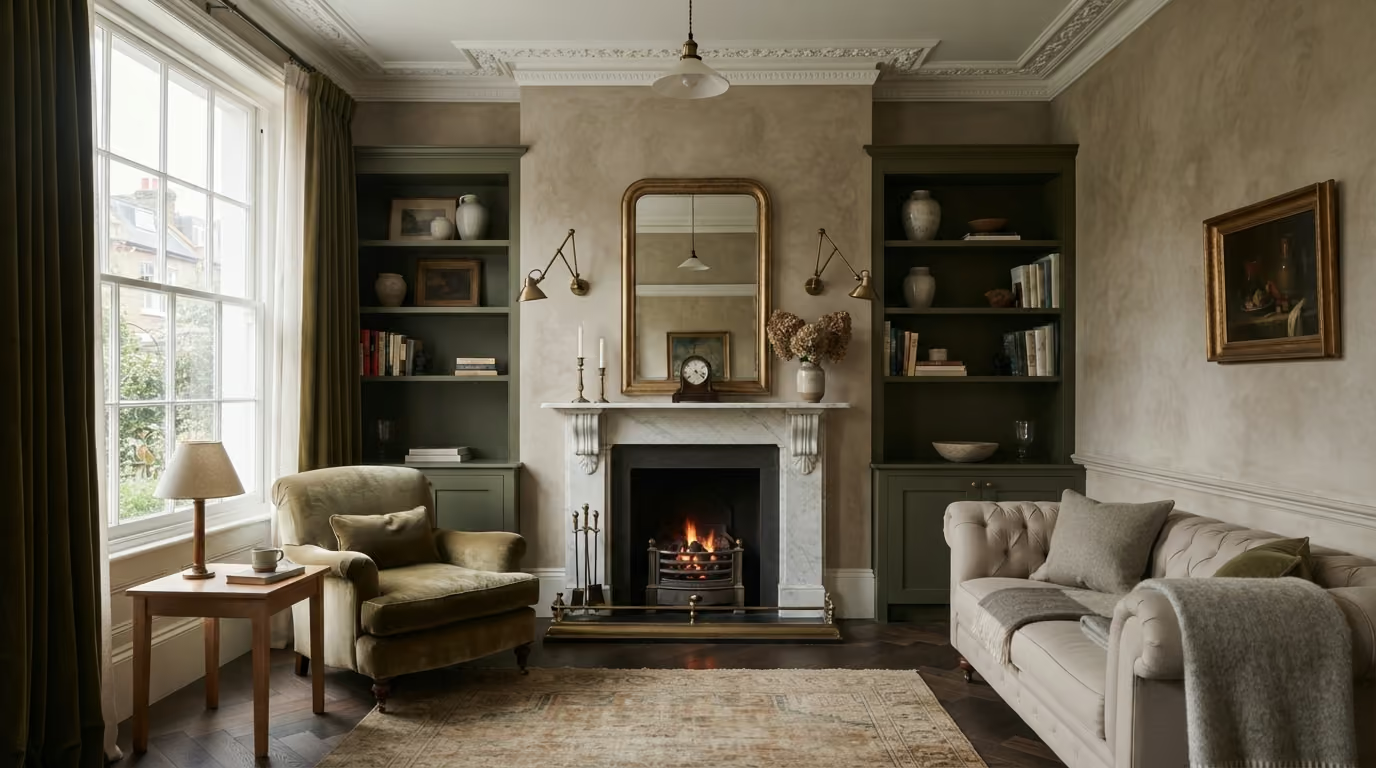
Bauwerk limewash can bring natural texture and depth to period fireplace walls without competing with original marble, limestone, or architectural details. This guide explains how to choose complementary colours, prepare chimney breasts, assess heat exposure, and coordinate limewash with alcove cabinetry, artwork, and lighting for a refined result.
The practical answer: Bauwerk limewash can create a beautiful finish around a period fireplace in a Chelsea home, particularly where the aim is to give the surrounding walls natural depth without competing with the stone, marble, or architectural detailing. It can be used on suitably prepared plaster and masonry, but the fireplace construction, existing coatings, surface condition, and potential heat exposure must be considered before application. The most successful results come from treating the fireplace and the surrounding walls as one decorative composition. For specialist preparation and application, see our Bauwerk limewash service.
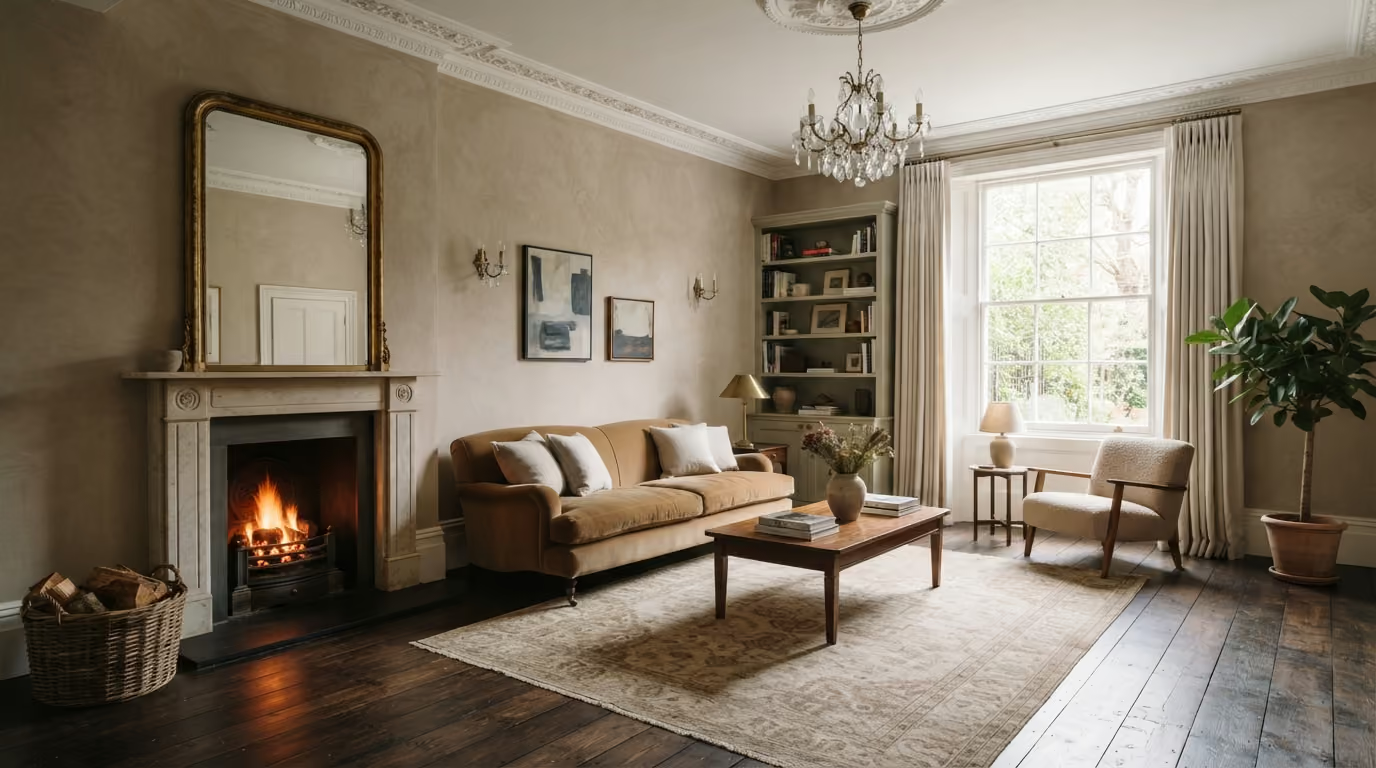
Fireplaces are among the most recognisable architectural features in Chelsea period homes. They may be framed by carved marble, limestone, painted timber, or simple plaster surrounds, often with a chimney breast extending towards an ornate ceiling cornice.
In many reception rooms, the fireplace provides the natural focal point. Furniture is arranged around it, artwork or a mirror sits above the mantel, and fitted cabinetry may occupy the alcoves on either side.
Choosing the right wall finish is therefore particularly important.
A conventional painted wall can create a clean, uniform background. Bauwerk limewash offers something different. Its mineral character and natural tonal variation can introduce softness around the architectural elements without relying on wallpaper or a strong decorative pattern.
This guide explains how to use Bauwerk limewash around period fireplaces in Chelsea homes, including colour selection, chimney breasts, stone and marble surrounds, preparation, heat considerations, alcove cabinetry, lighting, artwork, and the practical details that should be resolved before decorating begins.
A period fireplace often contains several different materials within one elevation.
These may include:
Each material has its own colour, texture, and response to light.
A limewashed wall can provide a softer background that allows these elements to remain distinct.
The natural variation of the finish can be particularly attractive beside polished marble, where the smoother stone surface contrasts with the more subdued appearance of the wall.
It can also complement limestone and other natural materials without requiring a strong colour difference.
The aim is not to make the fireplace disappear. It is to create a balanced relationship between the architectural feature and the wall surrounding it.
In many rooms, yes.
Continuing the same limewash across the chimney breast and adjoining walls can create a cohesive appearance.
This is particularly effective where the fireplace already provides enough visual interest through its shape, stone, or decorative detail.
Using one wall finish helps the eye read the chimney breast as part of the room rather than as a separate feature wall.
However, a different approach may be appropriate when:
The choice should follow the proportions and character of the room rather than a fixed rule.
Painting a chimney breast in a darker colour is a familiar decorating approach, but it is not always necessary.
In a Chelsea reception room with a substantial marble fireplace, introducing another strong colour can make the elevation feel unnecessarily divided.
A continuous limewash colour across the chimney breast and alcoves may create a calmer result.
If the fireplace needs additional definition, this can come from:
The chimney breast does not always need to become the darkest surface in the room to remain its focal point.
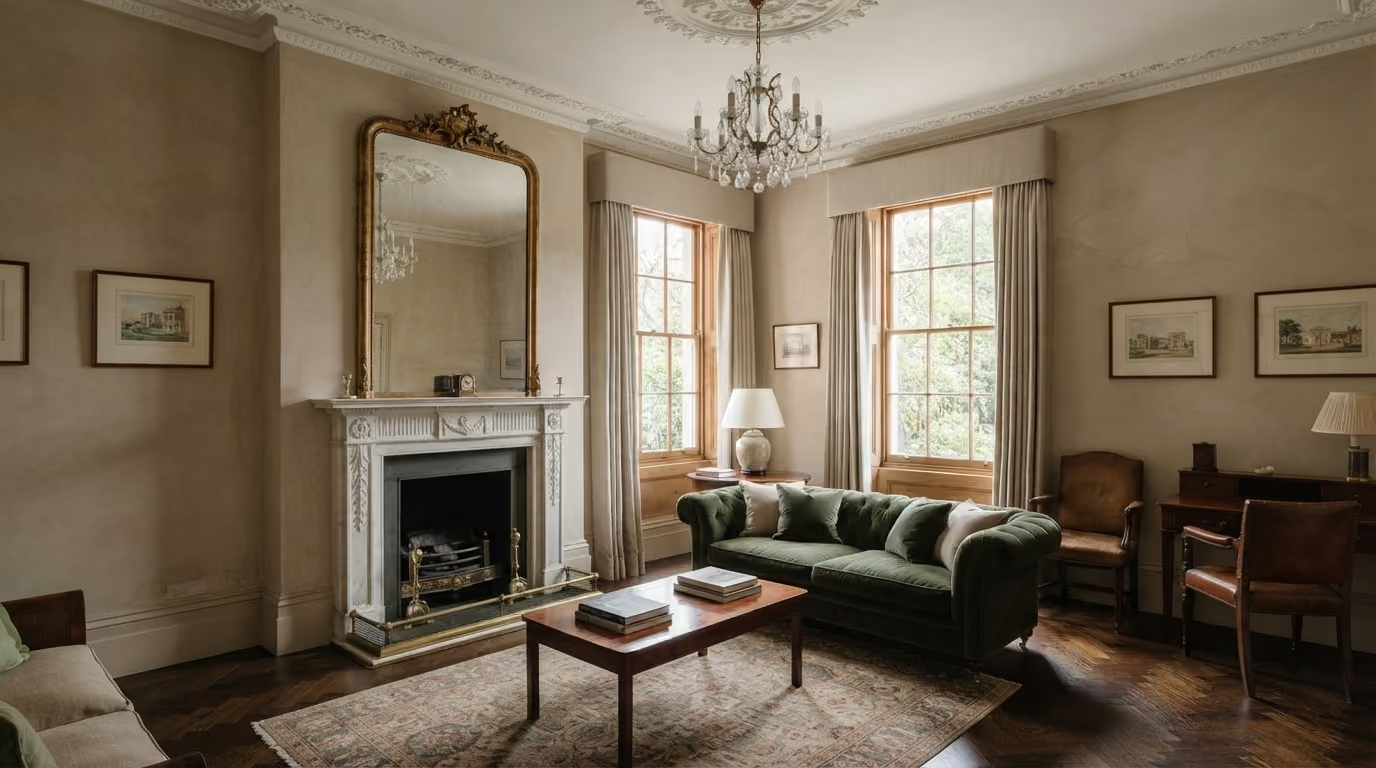
White marble fireplaces are common in formal period interiors, but they are rarely completely white.
They may contain:
The limewash should be selected with these characteristics in mind.
A warm stone wall can provide gentle contrast beside cooler marble. A pale grey limewash may create a quieter relationship with grey veining.
However, the undertones should always be tested together.
A limewash that looks neutral on its own may appear unexpectedly yellow, pink, or green when placed beside a particular piece of marble.
For this reason, samples should be viewed directly beside the fireplace rather than on an unrelated wall across the room.
Limestone often has a softer and more muted appearance than polished marble.
Its colour may range from pale cream and warm beige to deeper stone and grey tones.
When combined with limewash, the two materials can have quite similar visual qualities.
This can produce a beautiful result, but the colours need enough separation for the fireplace to remain defined.
Possible approaches include:
Matching the colours too closely can sometimes make the fireplace feel visually flat.
A subtle difference in temperature or depth may be enough to preserve its architectural presence.
Some fireplaces contain marble with substantial natural movement.
The stone may already introduce:
In these situations, a restrained limewash is often an attractive choice.
The wall can still have mineral variation without competing directly with the marble.
A quieter colour allows the fireplace to provide the main decorative movement.
This is particularly useful in rooms containing artwork, patterned rugs, or substantial curtains, where another visually demanding surface could make the scheme feel crowded.
The answer depends on the exact surface and fireplace construction.
There is an important difference between applying limewash to the decorative plaster wall surrounding a fireplace and applying a finish to masonry directly exposed to significant heat or flames.
Bauwerk Colour identifies limewash as suitable for appropriate masonry surfaces in fireplace settings, but the substrate and preparation method must match the specific application.
For example, raw absorbent masonry and previously painted plaster require different preparation systems.
The fireplace or stove manufacturer's requirements, applicable fire safety rules, and the condition of the installation must take priority.
Decorative primers, sealers, existing paint layers, and other materials should not be assumed suitable for high temperature exposure.
Any area directly exposed to flames or substantial heat needs its own technical assessment rather than being treated as an ordinary interior wall.
For further product guidance, see Bauwerk Colour's masonry surface guidance.
Before work begins, it is worth confirming whether the fireplace is:
This matters because the heat exposure and surrounding construction may differ substantially.
If the fireplace itself needs repair, adjustment, inspection, or specialist installation work, those stages should be completed before the final wall decoration.
Decorating should not be used to conceal cracks, staining, or other defects that may indicate a problem with the fireplace or chimney.
Older fireplace walls may contain staining from previous use.
Common signs include:
These areas should be assessed before the decorative finish begins.
The cause of any continuing staining needs to be identified, particularly where the fireplace is still in use.
Limewash should not simply be applied over contaminated or unstable surfaces in the hope that the marks will disappear.
The appropriate preparation depends on the substrate, staining, and the manufacturer's requirements.
Most Chelsea interiors have been decorated several times.
A chimney breast may contain old emulsion, local plaster repairs, filler, or areas where previous artwork or mirrors were attached.
Before applying Bauwerk limewash, the existing surface should be assessed for:
Bauwerk's preparation guidance for previously painted interior walls calls for suitable preparation, including Bauwerk Prep Coat, with additional priming where repaired or inconsistent surfaces require it.
This is important because mineral variation should come from the limewash finish itself rather than differences caused by poorly prepared repairs.
The wall above a fireplace often contains several generations of fixings.
Previous owners may have installed:
Removing these can leave holes, plugs, and uneven filler.
All unwanted fixings should be dealt with before the final decorative preparation.
If a substantial mirror or artwork will return to the same position, the fixing requirements should be considered early.
Drilling new holes after the limewash is complete can create local damage that may be difficult to disguise.
A fireplace is often positioned on an internal wall opposite or beside tall windows.
Natural light can travel across the chimney breast at an angle, making subtle surface variations more visible.
This can be attractive when the variation comes from limewash.
However, the same light can reveal:
The surface needs to be properly prepared before application.
Limewash is a decorative finish, not a substitute for correcting unsuitable plaster.
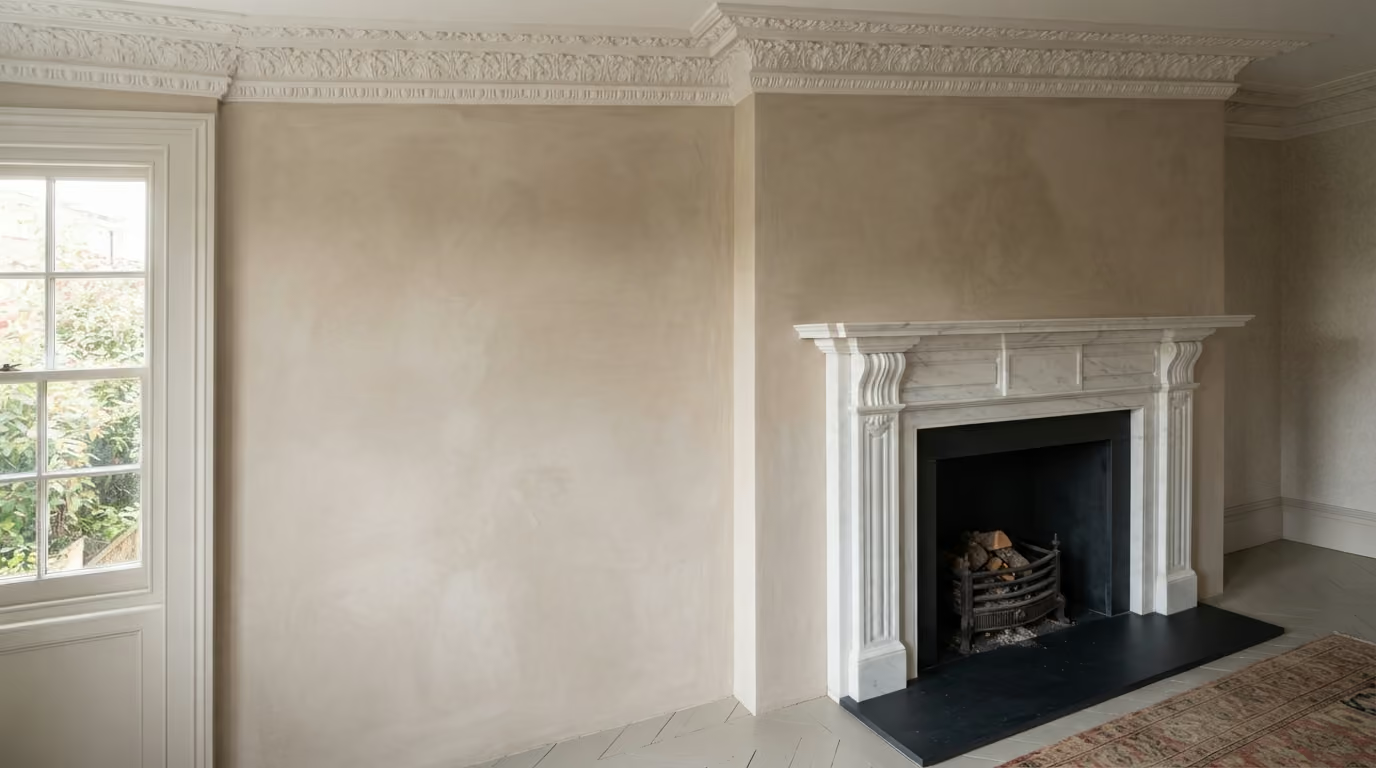
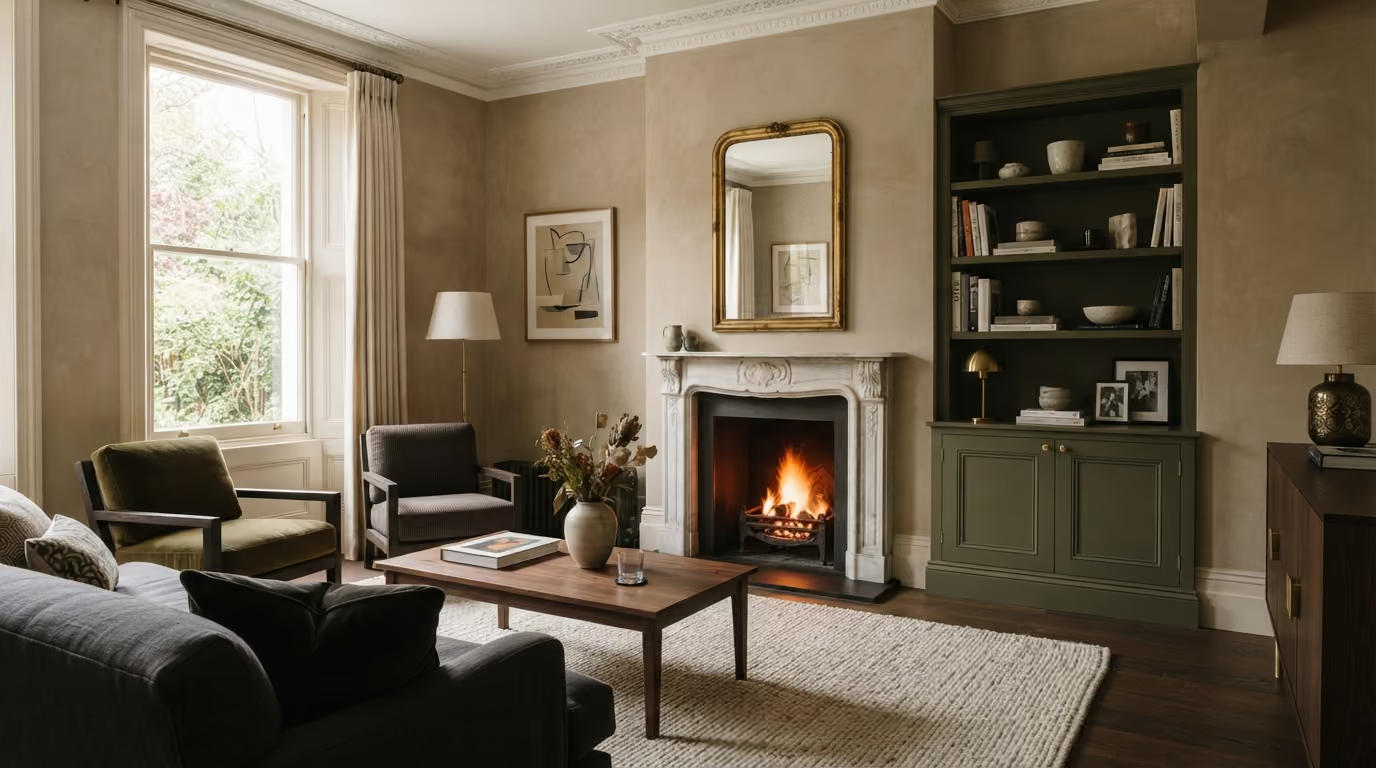
Many Chelsea reception rooms contain fitted cabinets on either side of the fireplace.
These may combine:
Their colour affects how the limewash appears.
Dark cabinetry beside pale limewash can create strong architectural contrast.
Softer neutral cabinetry can produce a quieter scheme where the fireplace remains the main feature.
Using similar tones for the cabinetry and walls can create continuity while allowing the difference between smooth painted joinery and mineral limewash to provide depth.
Cabinet samples should therefore be tested beside the proposed limewash colour.
It can, particularly where the shelving is designed to reveal portions of the wall behind it.
Limewash can provide a more layered background for books, ceramics, and decorative objects than a conventional uniform paint finish.
However, this should be planned before the shelving is installed or finally decorated.
Shelf positions, fixing points, and integrated lighting should be confirmed first.
If cabinetry is being installed after the limewash, drilling and local repairs may damage the finished wall.
It is usually preferable to complete the disruptive joinery work before the final mineral application.
Not every surrounding element needs to be painted.
Natural timber shelves, cabinets, and furniture can create warmth beside mineral walls.
This combination works particularly well when the room includes a stone fireplace.
The materials each provide a different surface character:
A restrained colour palette allows these differences to become the main decorative interest.
Some period fireplaces feature dark marble, black stone, cast iron, or deep timber surrounds.
Pale limewash can provide an effective contrast.
Warm stone, off white, pale putty, and soft clay can make a dark fireplace feel clearly defined without creating the starkness of brilliant white.
However, deeper wall colours can also work.
A dark fireplace against muted olive, warm charcoal, or tobacco limewash may create a more enveloping room.
The decision should account for the room's natural light and whether the fireplace needs to stand out or sit more quietly within the scheme.
Not automatically.
A Chelsea reception room may have ornate cornices and a ceiling rose that deserve their own decorative treatment.
Keeping the ceiling pale can provide a clear upper boundary and preserve a traditional room composition.
A related ceiling colour may create a softer transition.
The decision depends on:
If the cornice is painted separately, the edge between the limewash and painted plasterwork should be carefully planned.
The chimney breast may rise directly into a detailed cornice.
This junction can become highly visible once the new limewash is applied.
Old paint build up, small cracks, and uneven plaster should be assessed before the final decorative stages.
Where necessary, restoration or repair work should happen first.
The objective is to keep the original moulding profile defined while creating a clean transition to the mineral wall.
The area above a fireplace often holds one of the most important pieces of artwork in the room.
The limewash becomes its immediate background.
If the painting contains strong colours, a quieter mineral wall can provide balance.
If the artwork is more restrained, a deeper limewash may create useful contrast.
The frame is equally important.
Black, timber, gilt, bronze, and painted frames all respond differently to the surrounding wall colour.
When possible, test the limewash beside the actual artwork or a photograph showing its colours accurately.
Lighting directed across a limewashed wall can make its tonal movement more visible.
This can be particularly attractive above a period fireplace.
However, it also makes preparation defects more noticeable.
The position of picture lights should therefore be confirmed before decoration begins.
Electrical alterations, cable routes, and fixing holes should be completed before the final wall preparation.
A large mirror above the mantel reflects the surrounding room.
This can change how the limewash appears because the mirror may reflect:
When choosing a deeper wall colour, consider how it appears both directly and in the mirror.
A large mirror can make the room feel brighter, but it may also repeat a strong colour elsewhere in the space.
If a period fireplace is being restored as part of a larger refurbishment, it is sensible to complete the necessary specialist work before the final limewash.
This may include:
These activities may create dust or disturb the wall around the fireplace.
Final decorative work should happen once the disruptive stages are complete and the surrounding surfaces are ready.
Bauwerk limewash is valued for its natural, non-uniform appearance.
The finished colour may contain lighter and deeper areas that shift as the light changes.
This is different from visible problems such as:
Good preparation allows the intended mineral character to remain the main source of variation.
The application should follow the specified Bauwerk system for the actual substrate.
The most successful fireplace schemes balance several materials rather than relying on one decorative feature. Limewash can provide a soft background that supports the stone, joinery, artwork, and lighting without competing with them.
Can Bauwerk limewash be used on a chimney breast? Yes, on suitably prepared surfaces. The substrate and any heat exposure should be assessed before selecting the preparation and application system.
Does limewash work beside a marble fireplace? Yes. Its mineral character can create a beautiful contrast with polished or honed marble. Colour samples should be tested beside the actual stone.
Should the chimney breast be a different colour? Not necessarily. Continuing the same limewash across the chimney breast and adjoining walls can create a more cohesive appearance.
Can limewash be applied to exposed brick around a fireplace? Bauwerk provides guidance for applying limewash to suitable masonry, including brick. The preparation depends on whether the surface is raw, sealed, previously painted, or exposed to heat.
Can limewash cover soot staining? The cause of the staining should be investigated first. Contaminated surfaces may require suitable remedial work and preparation before any decorative finish is applied.
Which limewash colour works with white marble? Warm stone, putty, pale clay, and restrained grey tones can all work, depending on the marble's undertones and the room's light.
Can limewash continue behind alcove shelves? Yes, where the shelving design allows the wall to remain visible. Fixings, wiring, and joinery work should be completed before final decoration.
Will limewash make the fireplace stand out more? It can. The difference in texture between the mineral wall and stone or painted joinery may help define the fireplace without requiring dramatic colour contrast.
We carry out Bauwerk limewash and specialist interior decoration across Prime Central London, including Chelsea, Kensington, Belgravia, Notting Hill, Knightsbridge, and Westminster. Our projects include period reception rooms, drawing rooms, dining rooms, bedrooms, studies, entrance halls, and interiors where decorative finishes need to complement original fireplaces, stone, plasterwork, and architectural joinery.
Considering Bauwerk limewash around a period fireplace in a Chelsea home? Send photographs of the complete fireplace wall, including the mantel, chimney breast, alcoves, fitted cabinetry, surrounding plaster, cornices, and any colours or materials you are considering. Let us know whether the fireplace is decorative or operational so the appropriate surface and preparation requirements can be assessed. We can help plan a finish that complements the architecture and creates a refined relationship between the limewash, stone, joinery, and lighting. To begin, request a site visit and we will arrange a time that suits you.
Tell us a few details about your project and our team will review the enquiry and come back to you within one working day.


