

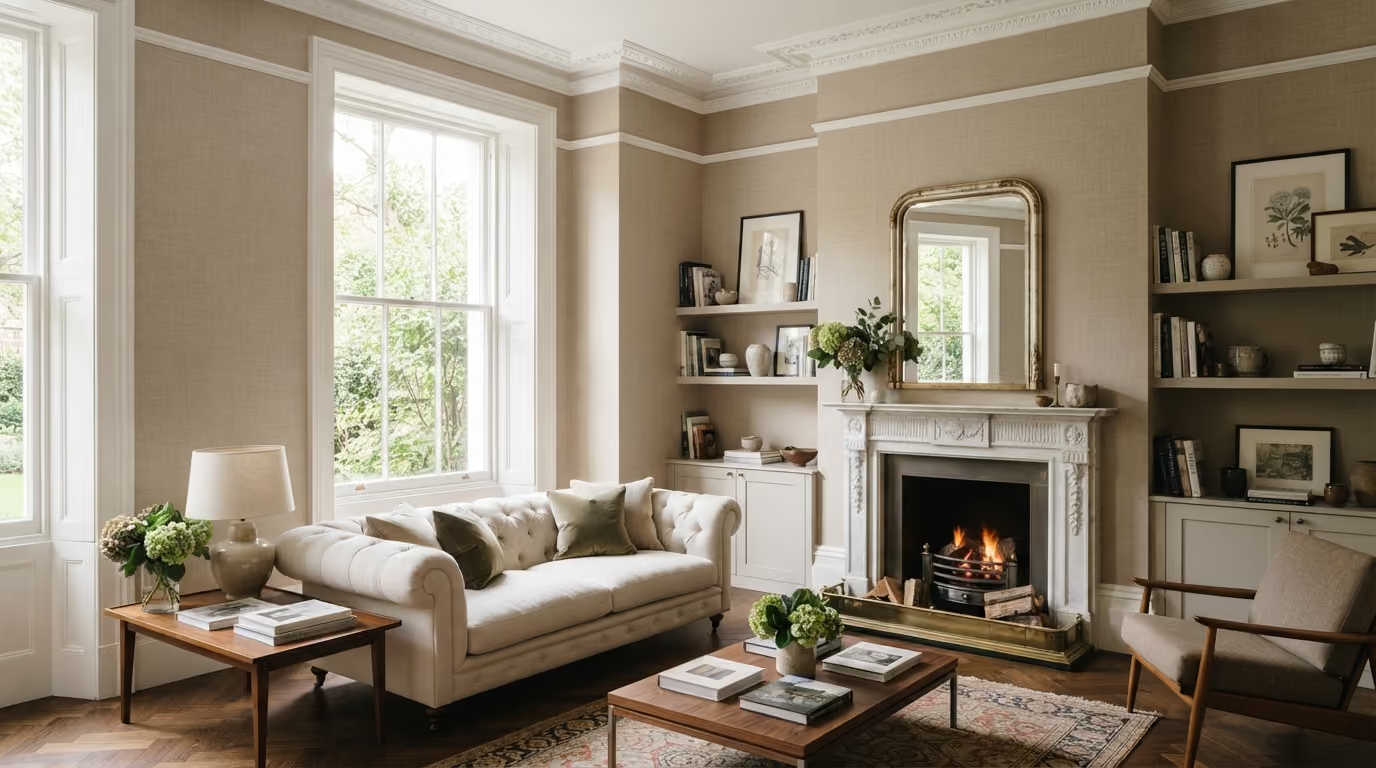
Uneven plaster, historic repairs, and irregular corners are common in Kensington period homes, but they do not always prevent a beautiful wallpaper finish. This guide explains how to assess older walls, prepare damaged surfaces, choose suitable wallcoverings, and achieve a refined result without unnecessary replastering.
The practical answer: Uneven walls in a Kensington period home can often be wallpapered successfully, but the preparation needs to address the condition of the plaster before the wallcovering is installed. Small imperfections, historic repairs, hairline cracks, and differences in surface texture do not automatically mean the entire room needs replastering. However, loose plaster, active cracking, damp, raised filler, and unstable previous coatings should not simply be covered with expensive wallpaper. The right preparation depends on both the wall and the material being installed. For professional assessment, preparation, and installation, see our wallpaper service.
Period homes in Kensington rarely have completely uniform walls. Even beautifully maintained properties may contain plaster that has been repaired several times, corners that are not perfectly square, and surfaces that have changed slightly over decades of decoration.
These characteristics are part of working with older buildings. They do not necessarily prevent the installation of a refined wallcovering, but they do affect how the project should be planned.
A delicate silk wallcovering, for example, may reveal imperfections that would be far less noticeable beneath a more heavily textured material. A geometric wallpaper with strong vertical lines can make an out-of-square corner more obvious. Grasscloth introduces its own natural variation, but it should not be relied upon to disguise unstable plaster or poor preparation.
This guide explains how to assess uneven walls before wallpapering, when local repairs are sufficient, when lining paper or more extensive plaster preparation may be appropriate, and how different wallcoverings behave on the historic surfaces commonly found in Kensington townhouses.
Often, yes.
The important distinction is between a wall that is slightly irregular but structurally sound and a wall with defects that could compromise the installation.
A period plaster wall may have gentle variations in its overall plane without presenting a serious decorating problem.
By contrast, loose plaster, recurring cracks, damp patches, or poorly bonded previous coatings require attention before wallpaper is considered.
During the initial assessment, it is useful to identify:
The chosen material matters because different wallcoverings have different substrate requirements.
Not every irregularity in an older wall needs to be removed.
Some Kensington properties contain original or long-established plaster that is not perfectly flat. There may be gentle undulations around window reveals, fireplaces, and older corners.
These characteristics can remain acceptable depending on the intended decorative result.
Problems that generally require closer attention include:
The aim should not automatically be to make a period room look like a newly constructed interior.
Instead, the wall should be prepared to a standard appropriate for the chosen wallcovering while respecting the architecture and condition of the property.
Old wallpaper can conceal a surprising amount of information about the wall beneath it.
In a property that has been decorated repeatedly, the existing finish may cover several generations of repairs.
Once removed, it may reveal:
This is why the true preparation requirements cannot always be determined from photographs of an existing wallpapered room.
The wall may look reasonably flat while the paper is still in place, only for defects to become apparent once the covering has been removed.
Allowing for this possibility is especially important when installing expensive specialist wallcoverings.
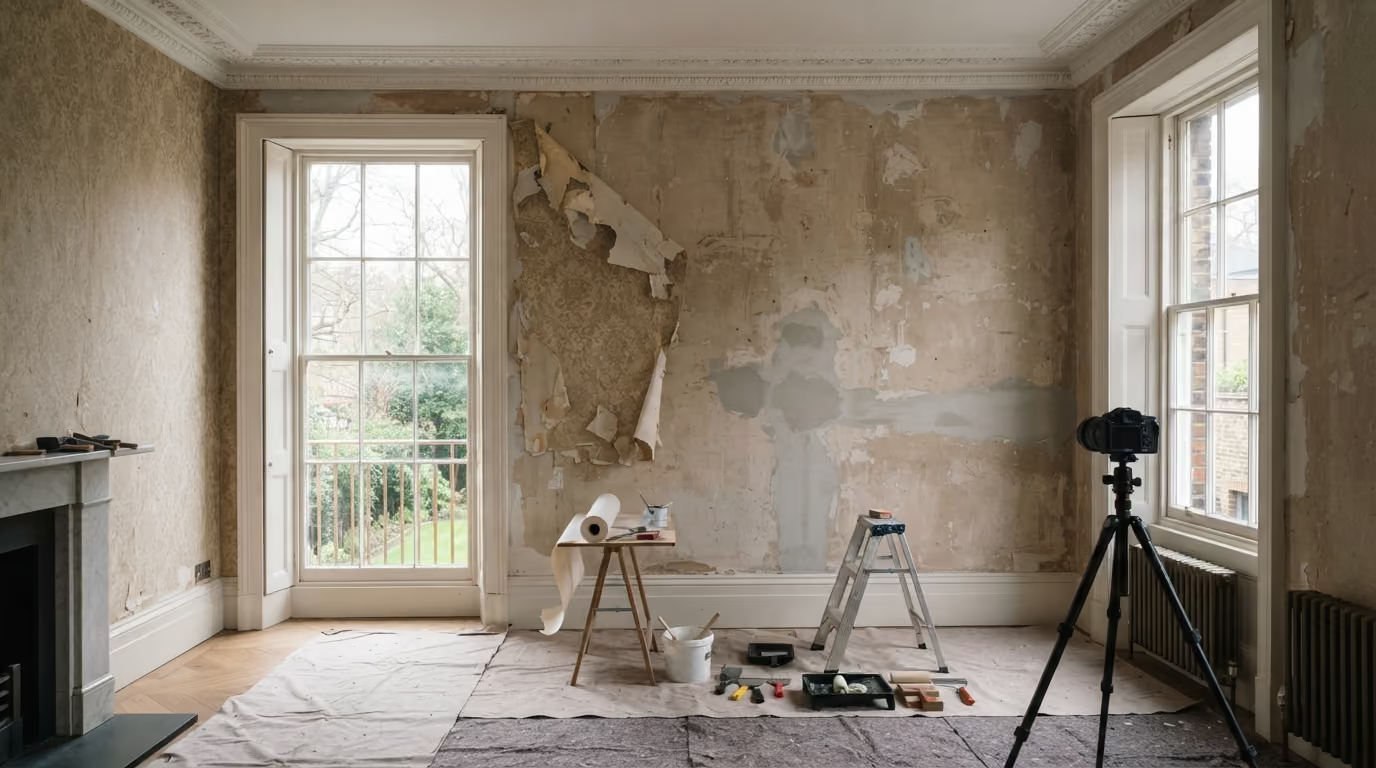
Residual adhesive should be addressed before the new wallcovering is installed.
Old paste can leave areas with different surface characteristics, and remaining contamination may interfere with subsequent preparation or installation.
Depending on its condition, the wall may require cleaning, further preparation, and a suitable primer or sealer as specified for the new wallcovering system.
The important point is not to assume that an apparently smooth wall is ready simply because the old paper has been removed.
The substrate needs to be inspected and prepared as a whole.
Hairline cracks are common in period properties.
They may appear around:
A stable crack may be suitable for decorative repair.
However, a crack that is widening, repeatedly reopening, or associated with movement should be investigated before being covered.
Wallpaper does not solve the underlying cause of a moving crack.
In some circumstances, the crack may eventually affect the wallcovering or become visible through the finish.
This is particularly important when a homeowner is investing in a premium material intended to remain in place for many years.
Previous repairs often create local high points.
A filler patch may look relatively harmless under ordinary room lighting, but once a wallcovering is installed, the raised edge can become visible.
This is especially noticeable with:
Preparation should aim to remove unsuitable ridges and create a consistent substrate.
Simply adding more filler to surrounding areas can make the problem larger if the repair is not finished properly.
Local repairs may be sufficient when the majority of the wall remains sound.
For example, a bedroom wall might have several old picture holes, a few shallow dents, and one stable repaired crack.
There may be no reason to replaster the entire surface if those defects can be prepared appropriately.
Local preparation may involve:
The condition should determine the work rather than applying a blanket rule to every room.
More extensive plaster preparation may be appropriate where defects are widespread.
This can include rooms with:
However, skimming is not automatically the answer to every uneven period wall.
Historic plaster may have particular characteristics that deserve careful assessment before alteration. In listed buildings or interiors containing significant historic fabric, more extensive work may also require specialist conservation advice or appropriate consent.
The decision should be proportionate to the wall condition, the property, and the intended result.
Lining paper can be useful in certain wallpaper preparation systems, but its role is often misunderstood.
It may help create a more consistent surface and reduce the visibility of minor imperfections when used with a compatible wallcovering and preparation method.
However, lining paper does not make unstable plaster sound, correct substantial changes in wall level, or resolve moisture problems.
It should not be treated as a substitute for necessary repairs.
Whether lining paper is suitable depends on:
For delicate or specialist materials, the preparation specification should be established before installation begins.
No.
Different wallcoverings may have different installation requirements, and there is no single preparation system suitable for every product.
Some manufacturers specify particular primers, liners, or other substrate preparation methods.
The correct approach is to identify the wallcovering first and establish what the manufacturer requires for the existing wall.
This becomes particularly important with specialist textile and natural fibre wallcoverings, where mistakes in preparation can be expensive to correct.
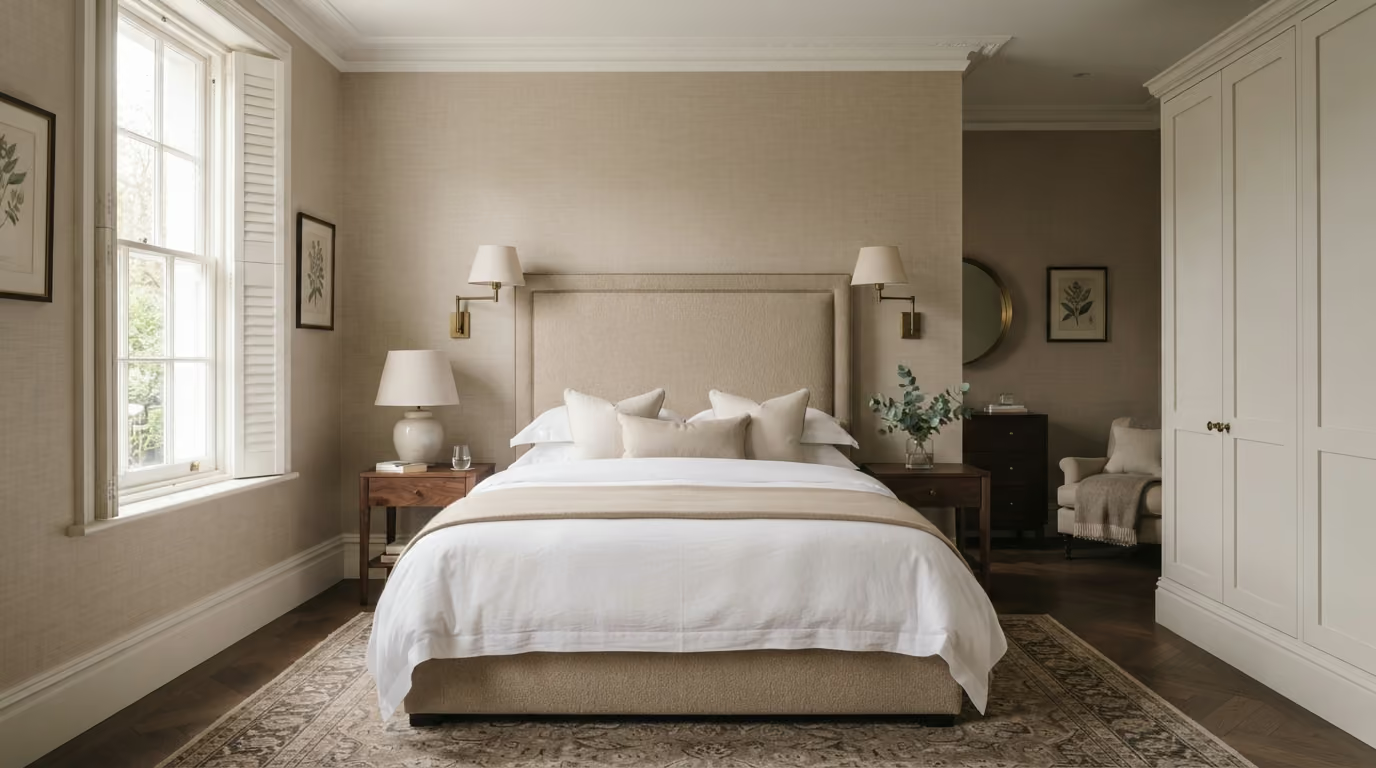
Silk can be especially effective in a Kensington bedroom, study, or reception room because it creates depth through light rather than strong printed pattern.
However, the same characteristics that make silk attractive can also make it demanding.
Depending on the material, light may reveal:
Preparation should therefore be planned around the specific product rather than assuming a delicate silk wallcovering will behave like ordinary printed wallpaper.
The homeowner should also understand the material's natural characteristics before the installation begins.
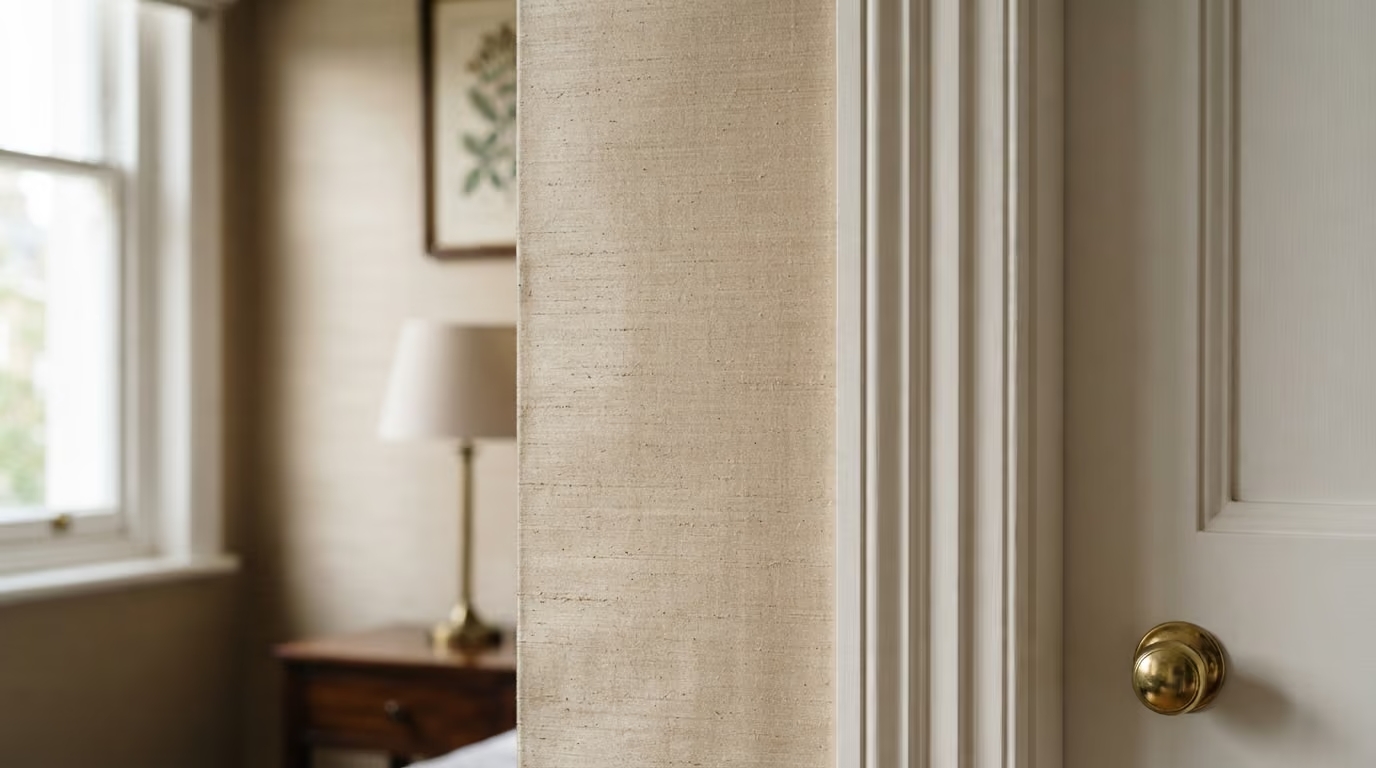
Grasscloth can look beautiful in period interiors because its natural fibres introduce warmth and visual movement.
It is particularly suitable for homeowners who appreciate materials that do not look completely uniform.
Natural grasscloth may show:
These characteristics are part of the wallcovering itself.
However, they should not be confused with defects caused by uneven plaster or inadequate preparation.
A natural material still needs a suitable substrate.
Large ridges, unstable areas, or badly repaired holes do not become acceptable simply because the wallcovering has texture.
Some textured wallpapers can make small visual imperfections less apparent than very delicate, smooth wallcoverings.
This may be useful when selecting materials for an older property.
However, the level and type of texture matter.
A fine woven effect behaves differently from a substantial embossed pattern.
The decision should consider:
Material selection can help create a suitable visual result, but it should not replace essential wall repairs.
Fabric backed vinyl is different from natural textile wallcoverings such as silk and linen.
It is often selected for interiors with greater practical demands, including certain hospitality and commercial environments.
For a private Kensington home, it may be appropriate where durability is a priority, but the aesthetic and technical requirements should be considered separately from those of natural textiles.
The backing material alone does not determine whether a wallcovering is suitable for an uneven substrate.
Period walls can be sound and appropriately prepared while still containing corners that are not perfectly vertical.
This becomes particularly important with geometric wallpaper, stripes, and designs with strong straight lines.
A vertical stripe may make an irregular corner more noticeable because the eye expects the pattern to remain straight.
Before installation, the wallpaper layout should take account of:
The installer should establish appropriate vertical reference lines rather than assuming that every corner of the room can be used as a reliable starting point.
Internal corners in older homes can be particularly challenging.
A wall may be slightly out of vertical, or the adjoining surfaces may not meet at a consistent angle.
Attempting to force a continuous length around an irregular corner can distort the material or affect the alignment of the pattern on the next wall.
The appropriate installation method depends on the wallpaper and the corner.
Careful planning is particularly important with strong geometric designs, where a small alignment problem can become noticeable across the next elevation.
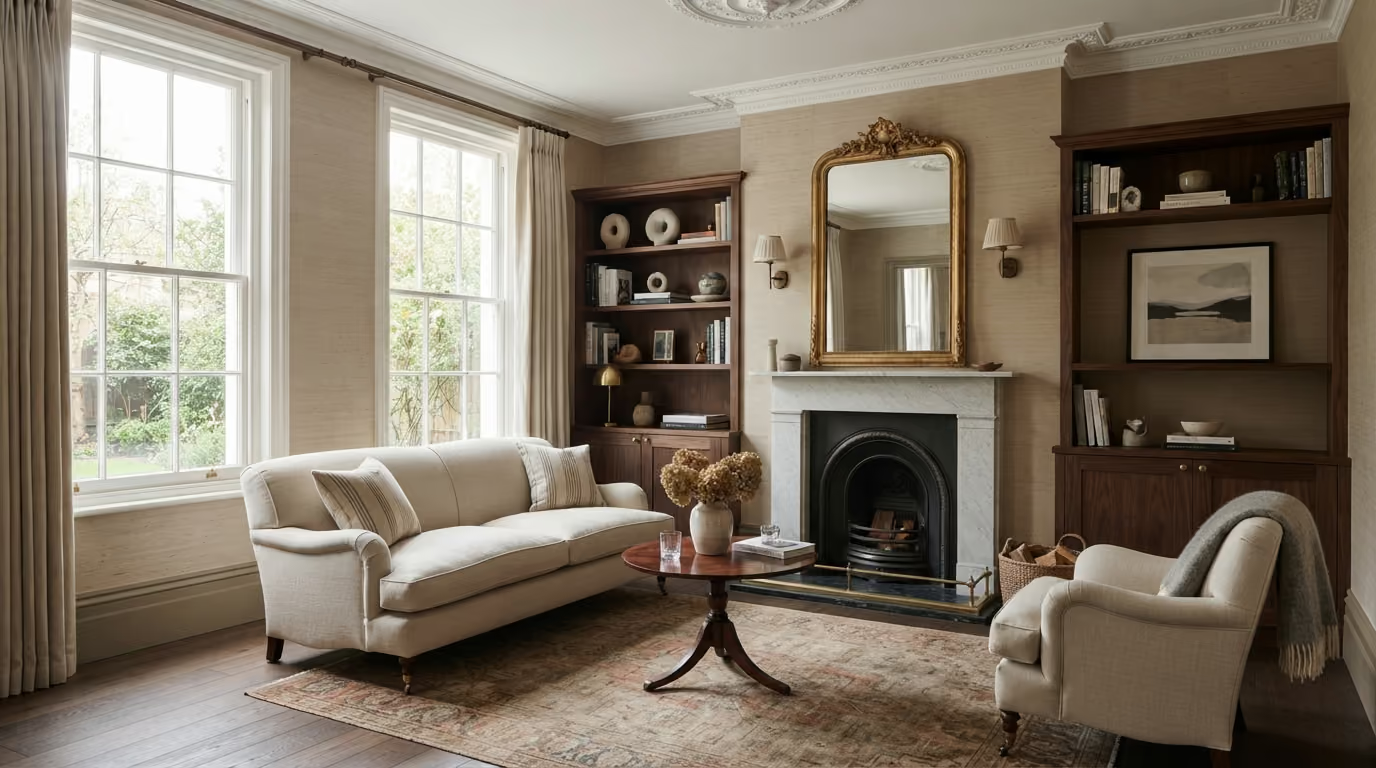
Kensington reception rooms often contain fireplaces with alcoves on either side.
These architectural features can make wallpaper layout more complicated because they divide the room into several narrower sections.
A large pattern may need to be positioned carefully so that an important motif does not finish awkwardly against the fireplace or disappear behind fitted cabinetry.
Before installation, consider:
These decisions become particularly important when walls are not perfectly square.
Many Kensington period rooms have tall sash windows that create strong side lighting.
Light travelling across a wall at a shallow angle can reveal imperfections that are difficult to see under ordinary ceiling lighting.
These may include:
Where a delicate wallcovering is planned, the prepared wall should be checked under the strongest natural light likely to reach it.
Picture lights and wall washers can produce a similar effect in the evening.
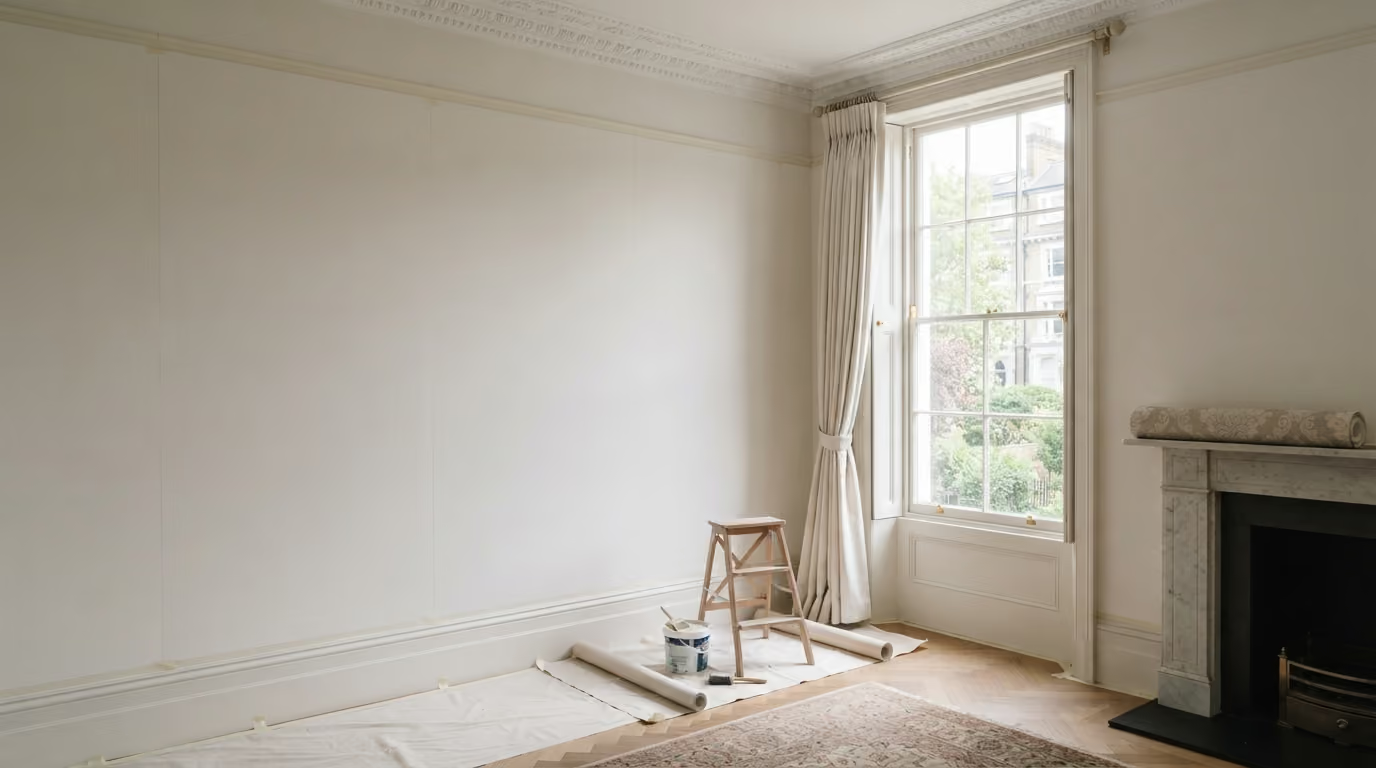
Damp is different from an ordinary surface imperfection.
If a wall contains persistent moisture, staining, or a recurring damp patch, the cause should be investigated before the new wallcovering is installed.
Possible sources include:
The important question is whether the source is still active.
Installing a premium wallcovering over a damp substrate can create unnecessary risk of failure or damage.
Older buildings may also contain traditional wall constructions that need appropriate moisture management, so the choice of decorative system should reflect the actual substrate.
If the wallpaper preparation includes plaster repairs or new skimmed sections, those surfaces need to be sufficiently dry and ready for the specified preparation system.
Drying conditions depend on:
A fixed decorating deadline should not override the condition of the substrate.
Rushing the work can compromise an otherwise carefully planned installation.
Wallpaper does not exist independently from the surrounding architecture.
In a Kensington townhouse, it may meet:
The quality of these junctions affects the entire appearance of the room.
Old paint build up, damaged plaster edges, or uneven transitions should be considered during preparation.
If doors, skirting, or other architectural joinery also need refinishing, this can be coordinated through our interior painting and decorating service.
Period rooms may have undergone several generations of electrical alterations.
Old sockets, wall lights, switches, and television points can leave holes and repair patches.
Before the final wallcovering is installed, confirm the positions of:
Unused holes should be repaired and the wall prepared before installation.
Moving electrical fittings afterwards may require local wallpaper repairs that are difficult to disguise, particularly with patterned or natural textile wallcoverings.
Fitted wardrobes, alcove cabinets, shelving, and wall panelling can all affect the surrounding plaster.
Installation may involve drilling, scribing, filling, sanding, and small adjustments to the wall surface.
Where possible, these stages should be completed before the final wallcovering.
This allows the wallpaper to finish cleanly against the completed joinery and avoids unnecessary disruption to newly decorated surfaces.
The best material should be selected for both its appearance and its suitability for the prepared substrate.
For a Kensington period interior, consider:
A suitable wallcovering should work with the property rather than being selected solely because it looks attractive in a showroom.
A successful installation does not necessarily require removing every sign of the property's age. It requires a stable, appropriately prepared wall and a material selected with the architecture and actual surface condition in mind.
Can wallpaper be installed on uneven plaster walls? Often, yes. Minor irregularities may be acceptable after suitable preparation, but loose plaster, significant ridges, unstable repairs, and moisture problems should be addressed first.
Does lining paper make uneven walls smooth? Lining paper can help with certain minor imperfections when it is part of a compatible preparation system. It does not correct substantial unevenness or stabilise damaged plaster.
Do period walls need to be skimmed before wallpapering? Not automatically. Local repairs may be sufficient when the existing plaster is sound. More extensive work may be necessary where defects are widespread.
Can silk wallcoverings be installed on older walls? Yes, provided the substrate is prepared to the standard required for the specific product. Delicate silk can make certain surface imperfections more noticeable.
Does grasscloth hide plaster imperfections? Natural texture can make some minor visual variation less apparent, but grasscloth should not be used to conceal unstable plaster, raised repairs, or damp.
Can wallpaper cover cracks in period plaster? Stable cracks may be repaired as part of preparation. Recurring or moving cracks should be investigated before the wallcovering is installed.
What if the corners of the room are not straight? The installer should plan the layout using appropriate vertical reference lines and account for the room's actual geometry, particularly with stripes or geometric patterns.
Should old wallpaper be removed first? Usually, yes. Removing it allows the underlying plaster, previous repairs, and adhesive residue to be assessed before the new wallcovering is installed.
We carry out wallpaper installation and specialist wall preparation across Prime Central London, including Kensington, Chelsea, Belgravia, Notting Hill, Knightsbridge, and Westminster. Our work includes period reception rooms, bedrooms, studies, dining rooms, hallways, dressing rooms, and other interiors where historic plaster, architectural details, and premium wallcoverings require careful preparation and precise installation.
Considering luxury wallpaper for uneven walls in a Kensington period home? Send photographs of the room, including the full walls, window reveals, corners, existing wallpaper, cracks, previous repairs, and any wallcovering samples you are considering. We can assess the visible condition, identify the preparation likely to be required, and discuss suitable materials and installation methods before the final decoration begins. To get started, request a site visit and we will arrange a time that suits you.

Tell us a few details about your project and our team will review the enquiry and come back to you within one working day.


