

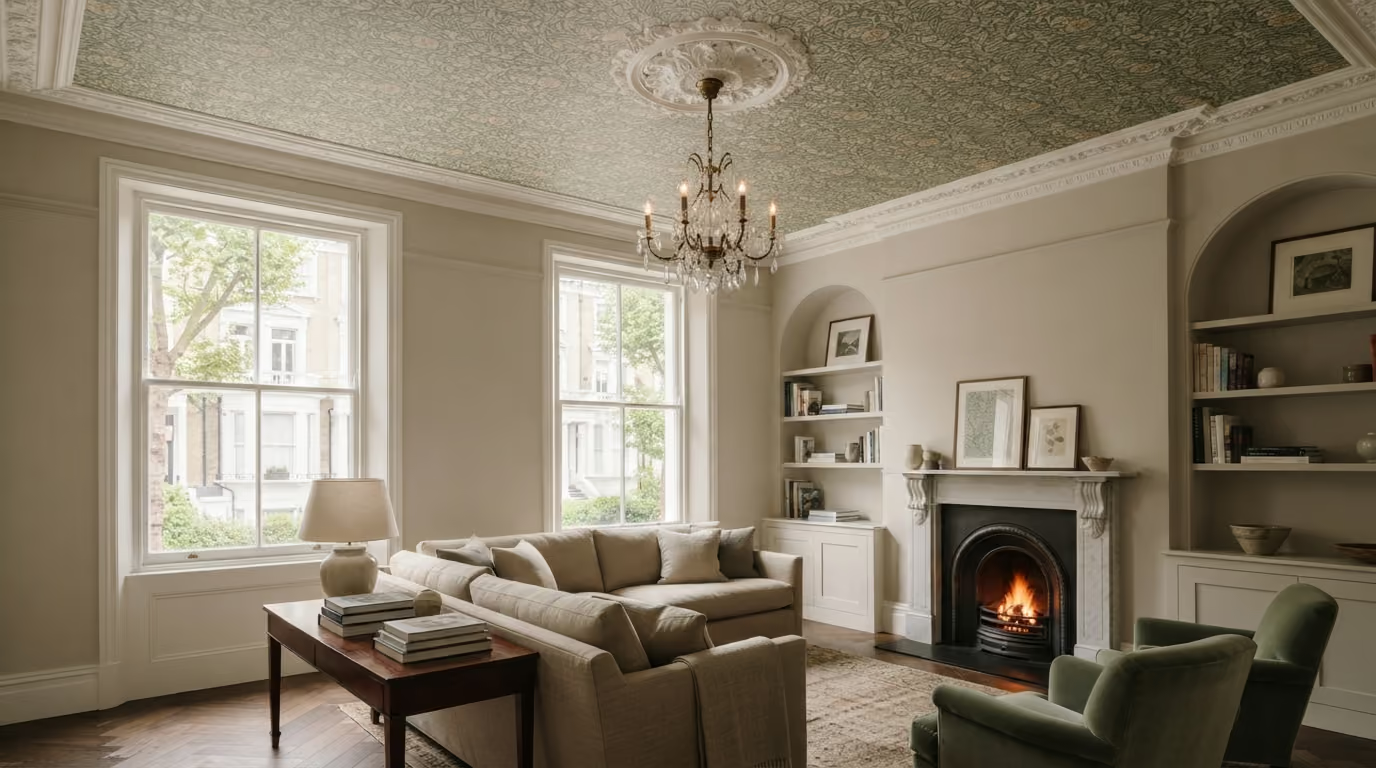
Wallpapered ceilings can bring subtle pattern, texture, and architectural interest to Chelsea period homes while preserving their original character. This guide explains how to choose suitable wallcoverings, prepare historic plaster, plan patterns around ceiling roses and ornate cornices, and coordinate colours and lighting for a refined result.
The practical answer: Wallpapering a ceiling can create a beautiful architectural feature in a Chelsea period home, particularly in bedrooms, drawing rooms, dining rooms, and studies where the ceiling forms an important part of the interior design. However, ceiling wallpaper requires more careful planning than a conventional wall installation. The condition of the plaster, the weight and type of wallcovering, the pattern layout, ceiling roses, cornices, lighting, and the manufacturer's installation requirements all need to be considered. For professional preparation and installation, see our wallpaper service.
In many Chelsea townhouses, ceilings are an important part of the architecture. Tall rooms, decorative cornices, plaster ceiling roses, and carefully proportioned windows create interiors where the upper surfaces deserve as much attention as the walls.
Traditionally, these ceilings are often painted white or a pale neutral. This can provide a timeless finish, but it is not the only approach.
Wallpaper can introduce pattern, texture, or subtle colour overhead, creating a different relationship between the ceiling and the rest of the room.
In a bedroom, a restrained textile-inspired pattern can make the space feel more intimate. In a dining room, a decorative ceiling can introduce interest without competing with artwork or furniture. In a study, a deeper colour or carefully selected pattern may create a more enclosed and distinctive atmosphere.
However, the installation should respect the original architecture. An ornate ceiling rose, for example, may deserve to remain exposed and painted rather than being covered or visually overwhelmed.
This guide explains how to choose wallpaper for period ceilings, assess existing plaster, plan the pattern, work around traditional architectural details, and coordinate the result with walls, lighting, and joinery.
Wallpapering the ceiling changes how a room is experienced.
Most interiors use the walls to provide colour and texture while leaving the ceiling relatively plain. Introducing wallpaper overhead creates another decorative surface without necessarily changing the arrangement of the room.
This can be particularly useful when:
The result can range from almost imperceptible texture to a bold decorative statement.
For many Chelsea period interiors, a restrained approach works particularly well because the architecture already provides significant visual interest.
Not every room requires a decorative ceiling.
The choice should depend on its proportions, natural light, architectural features, and how the space is used.
A bedroom is often a good place to introduce a subtle ceiling pattern.
The ceiling is visible when lying in bed, making its appearance more noticeable than in many other rooms.
Small-scale patterns, soft colour, and understated texture can create a comfortable atmosphere without making the room feel overly decorated.
In a bedroom with tall sash windows and a decorative fireplace, the ceiling design should complement these features rather than compete with them.
A formal drawing room may contain ornate cornices, a ceiling rose, a marble fireplace, and carefully selected artwork.
Wallpaper can work beautifully here, but the design requires particular restraint.
A fine pattern or softly textured finish may be more suitable than a large, visually dominant motif, especially where the ceiling contains substantial plaster decoration.
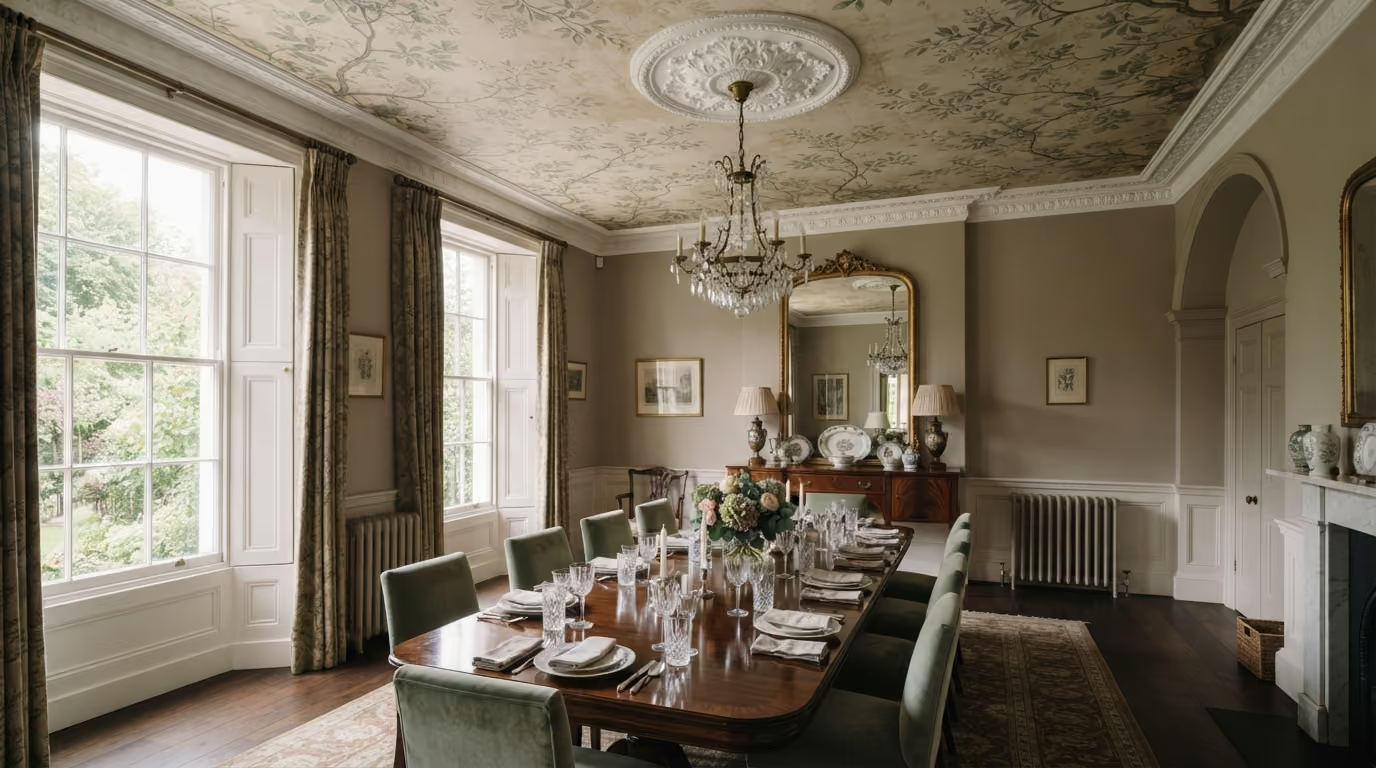
Dining rooms can accommodate a stronger decorative ceiling because their lighting and furniture arrangements often create a clearly defined central composition.
A chandelier or pendant light may provide a natural centre for the pattern.
The relationship between the wallpaper, light fitting, dining table, and cornices should be considered together.
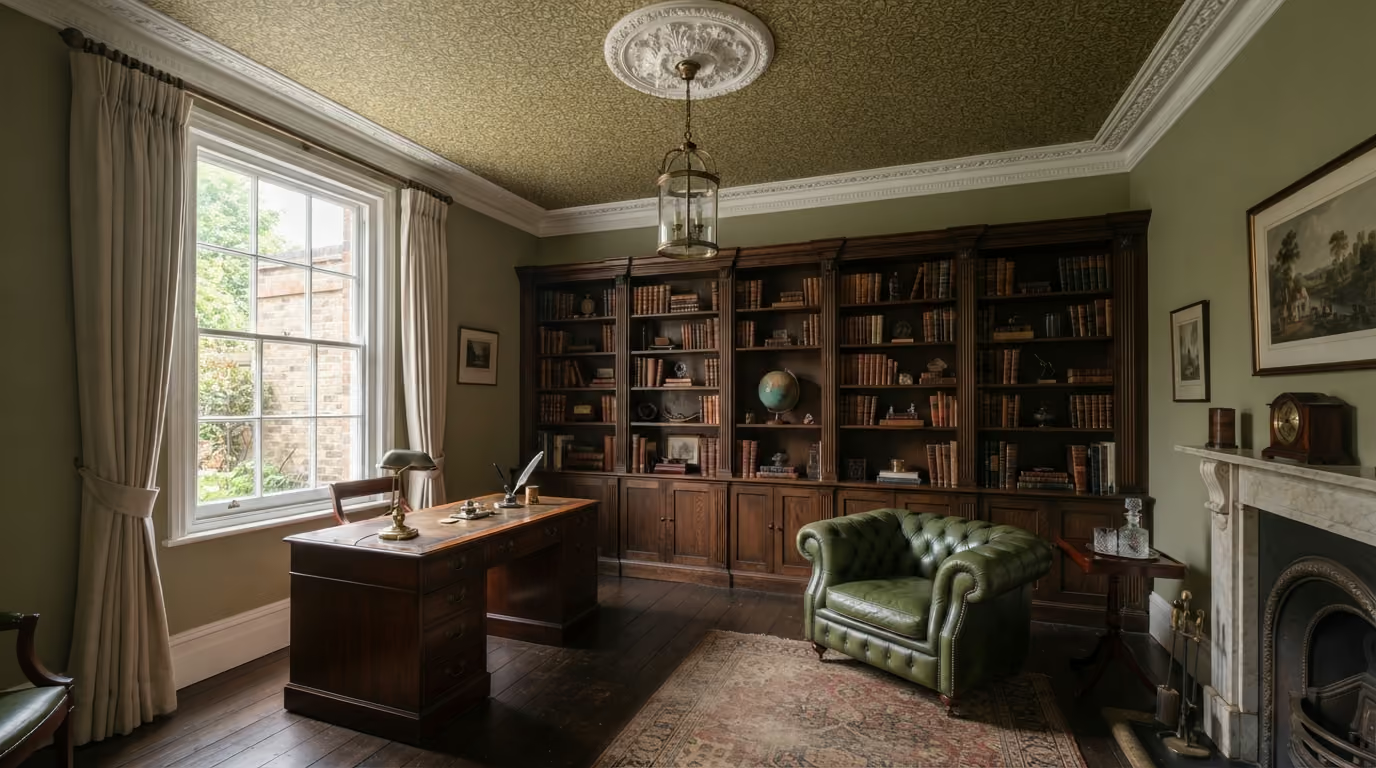
A study can benefit from a deeper or more textured ceiling treatment.
Where walls contain bookcases, paintings, and fitted cabinetry, the ceiling provides another opportunity to introduce colour or pattern.
However, the room should still feel comfortable during extended use, particularly where artificial lighting is important.
A ceiling that looks reasonably smooth from the floor may contain defects that become more apparent during preparation.
Before wallpaper is selected, inspect the surface for:
These conditions matter because the wallcovering will be installed overhead.
The ceiling needs to provide a stable and suitable substrate for the proposed material and adhesive system.
Wallpaper should not be used to hide plaster that is loose, unstable, or showing signs of an unresolved problem.
Some Chelsea period homes retain traditional plaster ceilings.
Depending on the age and construction, these may contain historic plasterwork, decorative mouldings, or plaster supported by traditional laths.
These surfaces should not automatically be treated in the same way as modern plasterboard ceilings.
The condition of the plaster and its attachment to the underlying structure are important considerations.
Where the ceiling contains cracking, visible movement, sagging, or areas that sound loose, specialist assessment may be needed before decorative work proceeds.
In a listed building, work affecting significant historic plaster may require additional conservation advice or consent.
The aim is to retain sound original materials wherever appropriate while creating a substrate suitable for the proposed finish.
Yes, where repairs are appropriate and the cause has been understood.
Hairline cracks are not unusual in older properties, particularly around ceiling junctions, historic repairs, and decorative plasterwork.
However, there is a distinction between a stable cosmetic crack and one associated with ongoing movement.
Before covering a crack, consider:
Wallpaper does not correct the cause of movement.
A crack that continues opening may eventually affect the decorative finish.
Ceilings may develop staining from historic roof leaks, plumbing problems, or water ingress from rooms above.
Before wallpapering, the source should be identified and resolved.
The surface must also be dry, stable, and appropriately prepared.
Applying wallpaper over an unresolved damp area can cause failure of the finish and may conceal further deterioration.
Where staining remains after the underlying issue has been repaired, the correct preparation will depend on the substrate and wallcovering specification.
Lining paper can be part of some ceiling wallpaper preparation systems, but it is not universally required.
Its suitability depends on:
A suitable lining system may help create a more consistent surface in some situations.
However, it does not make loose plaster stable, resolve water damage, or correct substantial surface defects.
The full preparation system needs to be planned before installation begins.
The appearance of a wallcovering is only one part of the selection process.
Its material, weight, flexibility, backing, and installation requirements are particularly important for a ceiling application.
Possible options may include selected:
The manufacturer should confirm that the specific product is suitable for the intended application.
A material marketed as luxury wallpaper is not automatically suitable for overhead installation.
Some specialist textile wallcoverings may be suitable for ceiling installations, depending on their construction and the manufacturer's technical instructions.
However, natural silk, linen, and other textiles have particular handling and substrate requirements.
They should not be selected simply because they would look attractive overhead.
Factors to check include:
Natural textile wallcoverings may contain visible seams or variation that forms part of their character.
The homeowner should understand these properties before making a final choice.
A wallcovering that performs well on a vertical surface may not have the same installation requirements on a ceiling.
Weight and the manufacturer's approved fixing system matter.
The adhesive, the surface preparation, and the condition of the ceiling must all be suitable for the material.
Heavy materials or products designed for different uses should not be installed overhead without clear technical approval.
This is particularly important in rooms containing original plasterwork or ceilings with several older decorative coatings.
Period rooms already contain strong architectural lines.
These may include:
A small-scale ceiling pattern can complement these elements without making the room feel overly busy.
Fine botanical designs, subtle geometry, and repeated motifs are possible directions.
The scale should be assessed from normal viewing positions within the room rather than judging the pattern only from a close-up sample.
A large ceiling pattern can create a striking effect, especially in a formal dining room or drawing room.
However, its placement becomes more important.
A motif that looks balanced on a flat sample may appear awkward when interrupted by a ceiling rose or chandelier.
Before installation, consider:
Where the pattern has a strong central motif, the layout may need to be planned around the room's architectural centre.
Not every ceiling is perfectly square, and this can affect how a large pattern appears near the cornices.
Decorative cornices are among the most important features to consider when wallpapering a period ceiling.
In many cases, the wallpaper should finish neatly against the inner boundary of the cornice, allowing the moulding itself to remain painted.
This preserves the definition of the original plasterwork.
However, the edge may not be completely straight or uniform, particularly in older rooms.
The junction needs careful preparation and installation.
Before work begins, inspect:
Any required plaster repairs should be completed before the final decorative finish.
There is no single correct choice.
A white or pale cornice can create a defined border around the wallpapered ceiling.
This is especially effective when the wallpaper contains colour or pattern.
Alternatively, the cornice may be painted in a tone related to the walls, creating a softer transition.
For a restrained period scheme, consider:
The best result depends on the height of the room and the amount of existing decorative detail.
A decorative plaster ceiling rose can be one of the defining features of a Chelsea period room.
It may contain floral motifs, geometric mouldings, or other traditional ornamentation.
Wallpaper should be planned around the rose rather than installed in a way that damages or obscures the detail.
The shape and scale of the rose will influence the pattern layout.
Before installation, consider:
A clean, well-planned junction allows the ceiling rose and wallpaper to complement each other.
Older rooms may not have perfectly symmetrical layouts.
A ceiling rose may appear slightly off-centre because of historic alterations, changes to the room, or the position of the original lighting.
This matters when selecting wallpaper with a strong geometric design or central motif.
If the wallpaper pattern is centred on the room but the rose is not, the difference may become noticeable.
The layout should be assessed before installation, considering what will look balanced from the room's main viewing positions.
A less directional pattern may be suitable where perfect symmetry cannot reasonably be achieved.
Ceiling wallpaper is viewed under different lighting conditions from wallpaper on walls.
Natural light may reach it indirectly, while chandeliers, pendants, wall lights, and picture lights can introduce different patterns of illumination.
A ceiling with subtle texture may look relatively uniform during the day but show more variation under evening lighting.
Strong directional lighting may reveal:
Samples should be considered under the actual lighting conditions of the room.
Ceilings often contain light fittings, smoke alarms, detectors, and other fixtures.
Their positions should be confirmed before wallpapering begins.
This includes:
Any necessary electrical changes should be completed by an appropriately qualified professional before the decorative installation.
Wallpaper should not obstruct fittings, electrical equipment, ventilation, or required access.
Moving a light fitting after the ceiling has been wallpapered may leave visible repairs or require replacement of a section.
On a wall, the orientation of a wallpaper pattern is usually easy to understand.
On a ceiling, its direction requires more thought.
A striped design, for example, may be aligned with the length of the room or across its width.
The decision can affect how the room's proportions are perceived.
For patterned wallpaper, consider:
The direction should be agreed before the material is cut or installed.
Ceiling wallpaper should be measured carefully before ordering.
It is not enough to calculate the square metre area and assume that is the required amount.
Pattern repeats, matching requirements, installation layout, and cutting allowances may increase the quantity needed.
Large designs can produce more waste than small-scale or random-match patterns.
The estimate should account for:
Ordering sufficient material from a consistent production batch is particularly important for expensive wallpapers.
A Chelsea period room may appear symmetrical while containing small differences in its actual dimensions.
Opposing walls may not be perfectly parallel, and corners may not meet at precise right angles.
These irregularities can affect the appearance of stripes, borders, and geometric ceiling patterns.
A professional layout should take account of the actual ceiling rather than relying on the room's corners as perfect reference points.
Where necessary, the positioning can be planned to minimise visual imbalance.
Choosing an appropriate pattern can be just as important as the installation technique.
A strongly coloured or heavily patterned ceiling can make the upper surface feel more prominent.
In a tall period room, this may be a desirable effect.
It can make a formal space feel more intimate and bring the decorative composition together.
In a room with a lower ceiling, the same treatment may feel visually heavy.
However, colour alone does not determine the result.
Pattern scale, lighting, cornice colour, wall colour, and the amount of furniture all contribute.
A pale, softly patterned ceiling can introduce interest without making the room feel noticeably enclosed.
Often, plain walls provide an attractive balance when the ceiling contains pattern.
This is especially useful in rooms with substantial furniture, artwork, or architectural detailing.
However, wallpapered ceilings can also work with patterned walls when the scheme is carefully coordinated.
Possible approaches include:
The key is to decide which surface should provide the main decorative interest.
Painted walls offer flexibility when introducing a decorative ceiling.
Colours can be selected from the wallpaper's background or from a quieter tone within the pattern.
For example, a muted green botanical ceiling may work with warm stone walls and soft ivory cornices.
A ceiling containing pale blue and cream may suit walls in a restrained blue-grey or warm neutral.
The surrounding joinery should form part of the same colour plan.
For coordinated wall, ceiling, and architectural woodwork finishes, see our interior painting and decorating service.
A wallpapered ceiling can also work with Bauwerk limewash on the surrounding walls.
The two finishes provide different kinds of visual interest.
Limewash introduces natural mineral movement, while wallpaper may provide a repeated pattern or more controlled texture.
This combination can be particularly attractive when both materials share a restrained colour palette.
For example:
However, a heavily patterned ceiling may compete with strongly varied walls.
The materials should be sampled together before the scheme is finalised.
For specialist mineral wall finishes, see our Bauwerk limewash service.
Installing wallpaper overhead is physically more demanding than applying it to a wall.
The work requires suitable access equipment, controlled handling of the material, and a carefully organised installation sequence.
In tall period rooms, the height makes access planning particularly important.
The installation team must be able to work safely while maintaining accurate alignment and handling the wallpaper according to the manufacturer's instructions.
Large or delicate lengths of wallcovering can be difficult to control overhead.
Safe working access should be planned as part of the project, not treated as an afterthought.
Ceiling preparation and wallpapering may take place above valuable architectural features and furnishings.
These might include:
The surrounding room should be protected before preparation and installation begin.
Where necessary, suitable furniture removal or repositioning should be coordinated with the work.
The scope of protection will depend on whether the project involves minor preparation or substantial plaster repairs.
Ceiling wallpapering is best coordinated with the wider room refurbishment.
A sensible sequence may involve:
The exact order may vary depending on the room and materials.
The important point is to prevent later building work from damaging the completed ceiling.
Repairs may be possible, but their visibility depends on the material and the location of the damage.
A random-match wallpaper may be easier to repair discreetly than a large geometric pattern.
Natural textiles, specialist papers, and heavily textured finishes can present additional challenges.
Even when a replacement piece is available, differences in age, light exposure, and production batch may affect the appearance.
For this reason, retaining spare wallpaper from the original installation can be useful.
Repairs should be assessed individually rather than assuming every damaged section can be made invisible.
Ceiling wallpaper generally receives less direct contact than wallpaper on walls, but it still needs suitable care.
Dust, accidental marks, humidity, and changes in the building can affect its appearance.
Maintenance should follow the specific manufacturer's instructions.
Not all wallcoverings can be cleaned with water or ordinary household products.
Particular care is needed with natural textiles and delicate decorative papers.
Where a mark or stain appears unexpectedly, especially near plumbing or roof areas, the possibility of an underlying moisture problem should be considered.
A successful wallpapered ceiling should feel like a considered part of the architecture. The pattern, colour, preparation, and installation need to support the original proportions and decorative features rather than overwhelm them.
Can wallpaper be installed on a ceiling? Yes, provided the ceiling is stable, suitably prepared, and the selected wallcovering and installation system are approved for overhead use.
Is ceiling wallpaper suitable for a Victorian townhouse? It can be. A carefully selected design may complement period proportions, cornices, ceiling roses, and traditional joinery.
Does a ceiling need lining paper before wallpapering? Not automatically. The preparation depends on the existing surface and the chosen wallpaper manufacturer's instructions.
Can wallpaper be installed around a ceiling rose? Yes. The layout should be carefully planned so the wallpaper finishes neatly around the plaster detail without obscuring or damaging it.
Is textured wallpaper suitable for ceilings? Some textured products may be suitable, but the individual material and installation system must be approved for the application.
Will ceiling wallpaper make a room look smaller? Strong colours and patterns can make a ceiling feel more prominent, but restrained designs may create interest without making the room feel significantly enclosed.
Can ceiling wallpaper work with patterned walls? Yes. The design needs to consider the relative pattern scales, colours, architectural details, and overall balance of the room.
Should the cornice be wallpapered too? In many period interiors, retaining the cornice as painted plasterwork provides a cleaner and more architecturally appropriate result. The approach should reflect the detail and condition of the moulding.
Can wallpaper cover cracks in an old ceiling? Suitable stable cracks may be repaired before installation. Cracks associated with movement, loose plaster, or other underlying problems require investigation first.
We carry out specialist wallpaper installation and interior decorating across Prime Central London, including Chelsea, Kensington, Belgravia, Notting Hill, Knightsbridge, and Westminster. Our work includes period drawing rooms, bedrooms, studies, dining rooms, entrance halls, and other interiors where decorative wallcoverings need to be carefully coordinated with historic plasterwork, ceilings, architectural joinery, and lighting.
Considering wallpaper for a ceiling in your Chelsea period home? Send photographs of the complete room, including the ceiling, cornices, ceiling rose, light fittings, existing plaster condition, and any wallpaper samples you are considering. We can assess the visible surfaces, discuss suitable materials and preparation requirements, and help plan the pattern layout so the finished ceiling complements the architecture. To get started, request a site visit and we will arrange a time that suits you.
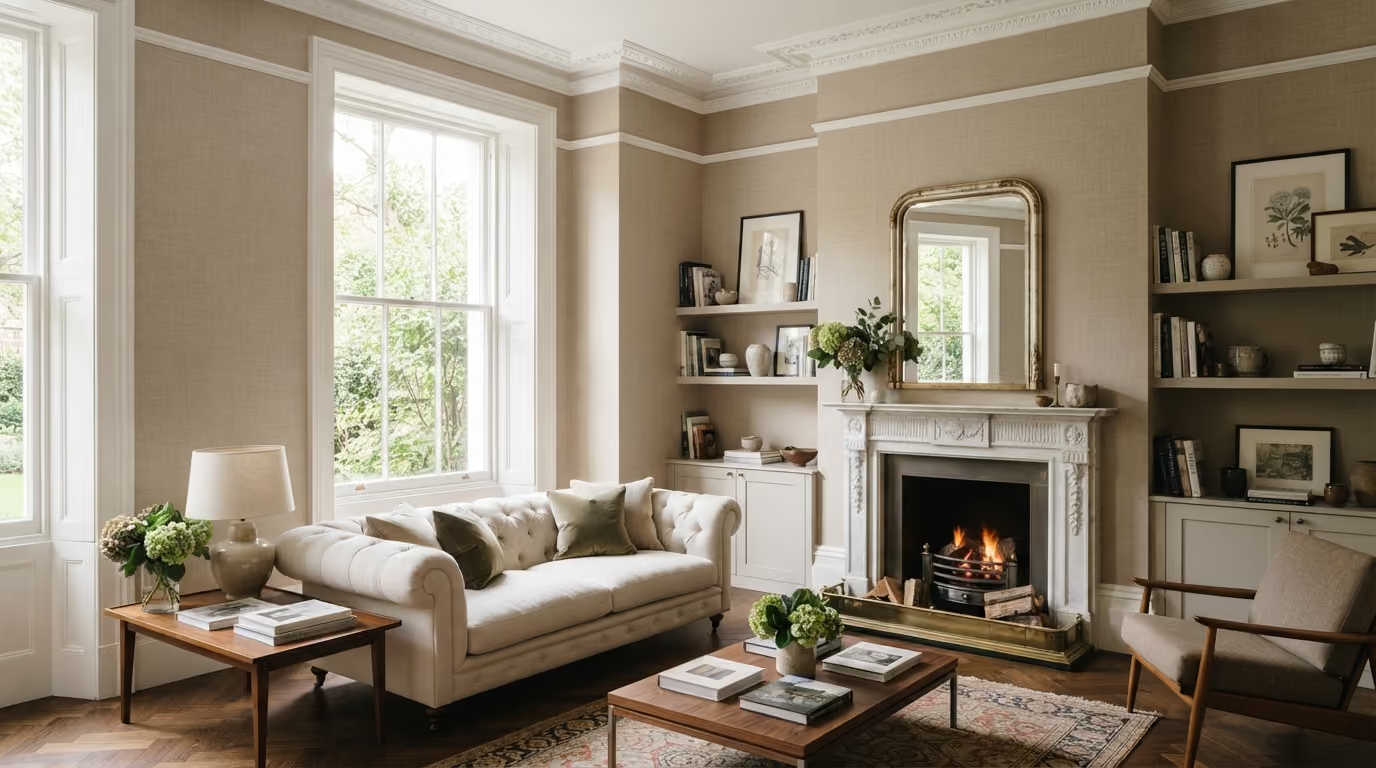

Tell us a few details about your project and our team will review the enquiry and come back to you within one working day.


